The day Breguet put gravity in a cage
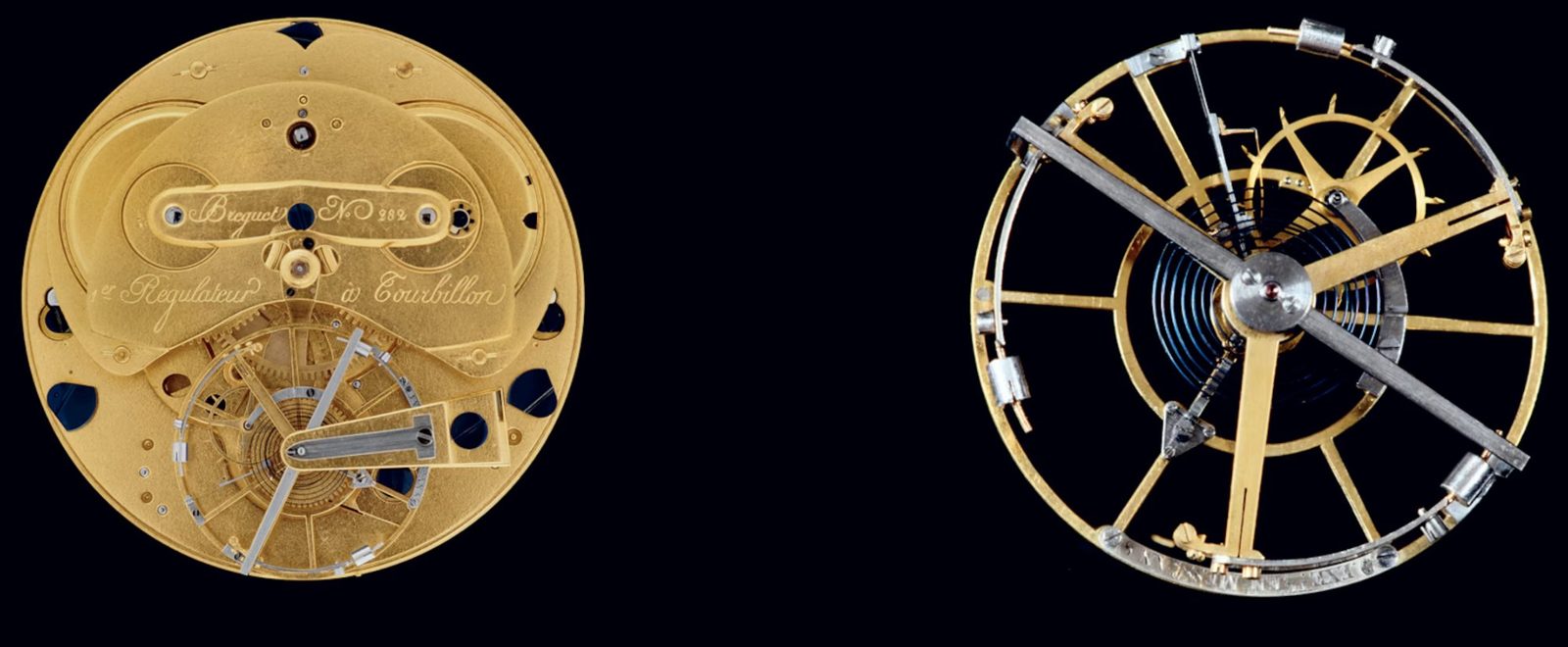
On 26 June 1801, in Paris, a watchmaker of fifty-four obtained from the Minister of the Interior a ten-year patent for what he called a new kind of regulator. The document carries a double date, revolutionary and Gregorian: 7 messidor year IX. Abraham-Louis Breguet had just patented the tourbillon. Two centuries later, that mechanism remains the surest way to drive up the price of a watch. The paradox is that it is of almost no use.
A very concrete problem, in 1801
To understand the invention, you first have to look at where a watch lived around 1800. It did not live on the wrist. It slept in a waistcoat pocket, hanging from a chain, almost always in the same vertical position, dial to the side. A mechanical watch is regulated by a minute and capricious organ: the balance, a weighted wheel that swings back and forth, and the escapement, the part that counts those swings and lets the spring’s energy out in regular bursts. That pairing is what cuts up time.
Breguet had observed the problem relentlessly. Gravity throws that little ballet out. When the watch stays upright, weight acts always the same way on the balance and its spring, and the rate slowly drifts. He dreamed of isochronism, that ideal regularity in which every swing lasts exactly the same time whatever the position. His answer was wildly elegant. Since gravity could not be removed, he would make it turn. Breguet placed the escapement and the balance in a moving cage that completes a full revolution, most often in a minute. As it pivots, the mechanism passes through every vertical position, and the errors, instead of adding up, cancel one another out. The watch corrects itself by turning on the spot.
The name he chose says a great deal about the man. According to the Federation of the Swiss Watch Industry, in the eighteenth century “tourbillon” belonged to the vocabulary of Cartesian cosmology, where it meant a planetary system turning about an axis. Where we would hear a storm, Breguet heard the mechanics of the heavens. This Enlightenment mind saw in a watch a reduced image of the cosmos, and he named his cage as one would name a system of stars.
Rare in his lifetime, already mythical
The invention had matured for a long time. Breguet, a refugee in Switzerland during the Terror, had conceived the principle around the middle of the 1790s, on his return to Paris. He filed the complete technical dossier, with a watercoloured drawing, on 24 December 1800, six months before the patent was granted. Building the object was another matter. The first tourbillon watch was not sold until around 1805, so much patience and handwork did the assembly of that cage demand.
The rarity of the thing has to be measured. The house’s archives, catalogued by the Federation of the Swiss Watch Industry, count only some forty of them between 1796 and 1829, pocket watches and a few clocks together, some of them taking five to ten years. Only a handful appeared in the inventor’s lifetime; he died in Paris on 17 September 1823. The tourbillon was one of his last great finds, that of a man at the height of his art, already watchmaker to the Navy and a member of the Academy of Sciences. A laboratory object as much as a luxury one, it was too costly and too delicate to spread.
A century of quiet refinements
After Breguet the tourbillon did not disappear, but it stayed the preserve of a few masters chasing absolute precision. The complication migrated to very specific ground, the observatory chronometry trials, where manufactures competed for the steadiest rate. There, in that learned competition, the mechanism still found a real use.
In 1892 a Danish watchmaker based in Coventry, Bahne Bonniksen, patented a variant cheaper to produce, the karrusel. The principle is a cousin: turn the regulating organ to average out positional errors. The construction differs and costs less, which won the karrusel a fine run of success in the British observatory trials for some twenty years. A logic was already taking shape, reproducing the effect of the tourbillon without its price.
The next step came from Germany. In 1920, at the Glashütte watchmaking school, Alfred Helwig developed the flying tourbillon. Where Breguet’s cage was held by two bridges, Helwig’s rests only on a lower support, invisible from above. The cage seems to float, weightless, spectacular to watch. The detail matters for the rest of our story. By the 1920s it was no longer only the accuracy of the tourbillon that was being refined, but also its staging.
The wrist changes everything
Meanwhile the watch had moved house. It had gone from the pocket to the wrist, and that quietly ruins the original argument. A wrist never stops moving. The watch changes position with every gesture, going from horizontal to vertical a thousand times a day. The errors due to gravity average themselves out, naturally, by the simple fact of moving an arm. The tourbillon had been conceived for an object that stays still for hours in a single position. On a wrist, it solves a problem that barely arises any more.
The watchmakers of the mid-twentieth century knew this perfectly well. When Omega built tourbillon movements from 1947, it was for the chronometry trials, not for sale. The complication remained a feat of the workshop, reserved for competitions and a few exceptional pieces. Nobody yet imagined turning it into a product.
The revival, or the art of selling a feat
Everything turned in the 1980s. Mechanical watchmaking came out drained from the quartz crisis, that cheap electronic watch which swept away a good part of the Swiss industry. To survive, the surviving manufactures stopped fighting on accuracy, ground where quartz crushed them, and went back to selling art, rarity, handwork. The tourbillon became the perfect emblem of that repositioning. In 1986 Audemars Piguet presented the first automatic tourbillon worn on the wrist, of unprecedented thinness. The complication came back out of the drawers, this time to demonstrate a craft that quartz would never reproduce, a difficult and living watchmaking, admirable under a sapphire crystal.
From then on the tourbillon multiplied. Cages doubled, tilted, turned on several axes. Then came the most revealing reversal. In the early 2000s the Chinese manufacturer Seagull developed its own tourbillon, soon offered in numerous calibres and models. What had cost a small fortune could now be found for a few thousand, sometimes a few hundred euros. The most prestigious complication in history had become accessible, and with that, slightly ordinary. Proof that its value never really rested on its function.
What this reveals
The tourbillon is the finest example of a principle that governs the whole of luxury watchmaking: perceived value and use value are two distinct things, and it is the first that sets the price. In a modern wristwatch a tourbillon barely improves accuracy, and a quartz chronometer costing a few tens of euros beats it hands down. Yet it sells for five or six figures. The reason comes down to a word. It is not paid for as an instrument, it is bought as a proof.
Proof of mastery first. Assembling and regulating a cage of a few dozen components weighing less than a gram calls for a hand machines have not replaced. Proof of lineage next. Acquiring a tourbillon means carrying off 1801, the Academy of Sciences and two centuries of history shut inside a small turning cage. The complication carries a story, and it is that story the customer straps to the wrist.
The lesson runs beyond watchmaking. In markets where the useful has become abundant and cheap, value migrates towards whatever attests to a craft and carries a memory. Quartz made the exact time nearly free, and mechanics fell back on handwork and myth. Breguet had solved a real engineering problem. His heirs understood that a solution grown useless could be worth more than in the days when it served, provided you knew how to stage it. The cage still turns. What it corrects now is no longer gravity, it is our relationship with value.
Key dates
| Date | Event |
|---|---|
| 10 January 1747 | Birth of Abraham-Louis Breguet in Neuchâtel |
| around 1795 | The tourbillon principle is conceived, after the Swiss exile |
| 24 December 1800 | The technical dossier is filed (3 nivôse year IX) |
| 26 June 1801 | Ten-year patent granted (7 messidor year IX) |
| around 1805 | First tourbillon watch sold |
| 1796-1829 | Some forty tourbillons leave the Breguet workshop |
| 17 September 1823 | Death of Breguet in Paris |
| 1892 | Karrusel patent by Bahne Bonniksen, in Coventry |
| 1920 | Alfred Helwig’s flying tourbillon, at Glashütte |
| 1947 | Omega tourbillon movements for chronometry |
| 1986 | First automatic tourbillon on the wrist (Audemars Piguet) |
| 2000s | Production Chinese tourbillon developed by Seagull |
Sources: official Montres Breguet site and house chronology
archives of the Swatch Group, owner of Breguet
Federation of the Swiss Watch Industry, entry on Breguet’s tourbillon (patent date, Cartesian etymology of the word, number of pieces produced)
Encyclopædia Britannica, biography of Abraham-Louis Breguet
official documentation of Glashütte Original and the Glashütte watchmaking school (Alfred Helwig, flying tourbillon of 1920)
documentation from the manufacturer Seagull.
Research and writing assisted by Claude Code.