Cartier Santos, how flight moved the watch to the wrist
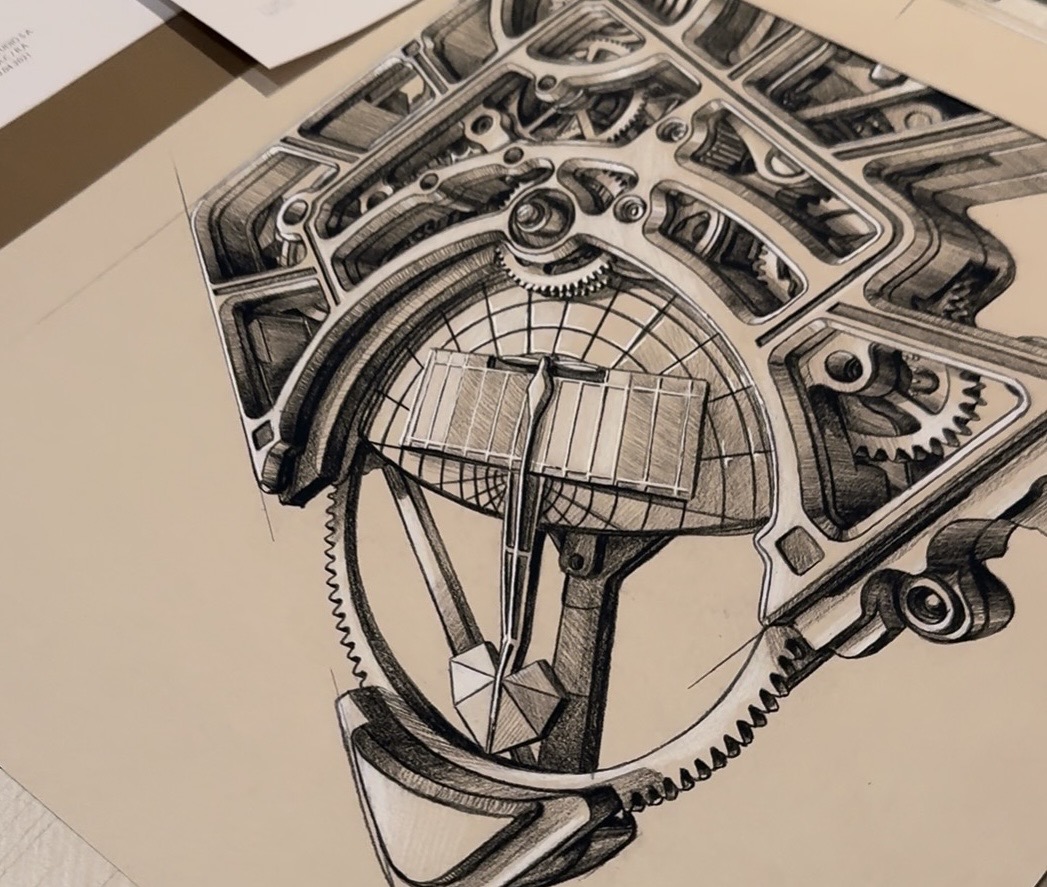
In 1904 a Brazilian aviator wanted to read the time without letting go of his airship’s controls. The jeweller of the place Vendôme built him a watch to wear on his arm. Out of that technical whim came one of the first men’s wristwatches designed around a use, and one of the quietest turning points in the history of the object.
A Brazilian dandy over Paris
Alberto Santos-Dumont was born on 20 July 1873 at Cabangu, in the Brazilian state of Minas Gerais, the son of a coffee planter who had made his fortune. The family money bought him Paris, an engineering education and, very quickly, an obsession with leaving the ground. He started with balloons. His first, the Brésil, went up in 1898. Then came the airships, motorised envelopes he flew standing in a basket, and close to a dozen of them would leave his workshops in a decade.
On 19 October 1901 he became a worldwide celebrity. Aboard his airship number 6 he took off from Saint-Cloud, rounded the Eiffel Tower and came back in under half an hour, a journey of a little over eleven kilometres that won him the Deutsch de la Meurthe prize and 100,000 francs. Fashionable Paris raised him to the skies. Small, immaculately dressed, he lunched at Maxim’s and drifted through the salons. It was there, in that social whirl, that he met an ambitious young jeweller with a dream of his own, to bring his family house into the twentieth century: Louis Cartier.
The watch that would not leave the pocket
At the turn of the century, a man who wanted the time pulled it out of his waistcoat. The pocket watch, tethered by its chain, was the masculine accessory. The bracelet was read as feminine coquetry, a piece of jewellery. No gentleman would have been seen with a watch on his wrist.
The trouble, when you are flying an airship, is that both hands are taken. Rummaging in a waistcoat, springing a case open, reading a dial, all of it means letting go at the worst possible moment. Santos-Dumont is said to have complained about it to his friend Cartier. The jeweller’s answer is one the house still tells on its own materials:
In 1904, Louis Cartier granted the wish of the celebrated Brazilian aviator Alberto Santos-Dumont: to be able to read the time while flying. The birth of one of the very first wristwatches sealed the friendship between these two pioneers.
Cartier, official presentation of the Santos collection, translated from the French
What came out broke with the usual roundness. A square case with softened corners, a dial read at a glance, a bezel with exposed screws that would later become the line’s signature. Nothing in that drawing is decorative: it comes from the constraint. A shape you read fast, a strap that holds to the arm, a watch you do not drop in flight. Function dictates the line. One caution belongs here. The year 1904 is the one Cartier puts forward in its own account, and the exact chronology of that first piece rests largely on the memory of the house rather than on an archive document dated to the day. It is taken for what it is, the founding date as Cartier establishes it.
What the Santos did not invent
It would be wrong to write that the Santos was the first wristwatch. It was not, and the distinction matters.
Nearly a century earlier, Abraham-Louis Breguet had already answered a commission of this kind. On 8 June 1810, Caroline Murat, queen of Naples and younger sister of Napoleon, ordered from him a watch to be worn on the wrist. He conceived it as an ultra-thin repeater, oblong in shape, mounted on a bracelet of hair plaited with gold thread. Finished at the end of 1812, after more than two years of work, it is described by the Breguet house as the first wristwatch ever known. Other women’s pieces and a handful of watches strapped to the arm by military men existed through the nineteenth century, often improvised, often unique.
The Santos is singular for another reason. It was made for a man, for a precise professional use, by a house capable of producing it and, soon, of selling it. Where Caroline Murat’s watch stayed a one-off princely commission, the Santos was going to become a model. Once the prototype had been given to the aviator, Cartier put it into its commercial offer at the start of the 1910s. The exact date it went on public sale is open to discussion, and in the absence of a first-hand archive it is better to stay careful. A yellow gold example from 1912, held in the Cartier Collection, is presented there as one of the very first Santos wristwatches created by Cartier. So the Santos can be taken as a saleable product at the very beginning of that decade, without fixing a year the primary sources do not confirm.
The trenches finished the job
Between the 1904 prototype and the wristwatch as masculine norm, the years cannot be skipped. Santos-Dumont went on flying. On 23 October 1906, before the Aéro-Club de France, he got his 14-bis off the ground over some sixty metres and took the Archdeacon cup. On 12 November he did it again, covering 220 metres in twenty-one and a half seconds, a few metres above the ground. The Fédération aéronautique internationale ratified the performance: the first recognised world record for a heavier-than-air machine. In 1909 he presented the Demoiselle, a small light monoplane. The pioneer stayed active until the war.
That same watch on the wrist, the one that helped a man fly, found its real accelerator in the mud. The First World War, from 1914 to 1918, forced the bracelet onto millions of men. In a trench, under a barrage, an officer who has to time an assault to the second cannot go digging through his tunic. The wrist becomes the obvious tactical answer. Soldiers first strapped pocket watches to their arms, then industry followed and made pieces designed for the purpose, something the Imperial War Museum collections document at length. When the war ended, those men went home with the habit. What had passed for women’s jewellery ten years earlier had become the mark of the man of action, the veteran, the modern.
The 1920s and 1930s confirmed the reversal. The men’s wristwatch stopped being a daring gesture and became a standard, and Cartier played the Santos as an object of style as much as of use. Santos-Dumont himself would not really see that watchmaking glory. Ill, depressed, haunted by the military use of the aviation he had loved so much, he took his own life on 23 July 1932 at Guarujá, in the state of São Paulo. He was fifty-nine. The watch that carries his name would outlive him far beyond anything he could have imagined.
The lesson
The story of the Santos describes a mechanism the watch industry has never stopped replaying. An object is born of a raw need. Nobody put the watch on the wrist out of taste; it went there because both hands were taken, first in flight and then in the trenches. The form follows the constraint: a square dial read at a glance without leaving the controls. At that stage the watch is a tool, and its drawing is only the visible trace of what it does.
Then the function becomes ordinary, and that is where everything is decided. When everyone wears a watch on the wrist, usefulness no longer distinguishes anyone. The object slides out of the register of use and into the register of the sign. The square drawing of the Santos serves no particular purpose in the twenty-first century, where a phone gives the time better than it does, and yet it has become a code, a way of recognising one another among the initiated, a marker of status. What the watch says about the person wearing it has overtaken what it does.
That journey, from tool to totem, explains the strategy of the whole of contemporary luxury watchmaking. A brand that owns an object born of a real use holds a story marketing cannot manufacture afterwards. The Santos sells a pilot, a Paris sky in 1904, a friendship, and that original functional legitimacy is what licenses every price that follows. The houses have understood it, endlessly exhuming the first cockpit watch, the first diving chronograph, the first antimagnetic calibre. The vanished use becomes an argument for desire.
One warning remains, and it decides everything. What gives the Santos myth its force is that the need was true. A pilot really did have both hands taken in 1904. The day the story comes before the use instead of following it, all that is left is advertising dressed up as legend.
Key dates
| Date | Event |
|---|---|
| 8 June 1810 | Caroline Murat, queen of Naples, orders from Breguet a watch to be worn on the wrist (delivered 1812) |
| 20 July 1873 | Birth of Alberto Santos-Dumont, Minas Gerais, Brazil |
| 1898 | First balloon, the Brésil |
| 19 October 1901 | Deutsch de la Meurthe prize, airship no. 6, Saint-Cloud to the Eiffel Tower and back |
| 1904 | Louis Cartier creates the Santos watch for Santos-Dumont (date established by Cartier) |
| 23 October 1906 | Archdeacon cup, flight of the 14-bis (approx. 60 m) |
| 12 November 1906 | 220 m in 21.5 s, first world record ratified by the FAI for a heavier-than-air machine |
| 1909 | Demoiselle monoplane |
| Early 1910s | The Santos enters Cartier’s commercial offer (a 1912 example survives, one of the very first) |
| 1914-1918 | The First World War makes the wristwatch general among men |
| 23 July 1932 | Death of Santos-Dumont at Guarujá, São Paulo |
Sources: official presentation of the Santos collection and the Cartier Collection on cartier.com
Maison Breguet, breguet.com, for Caroline Murat’s 1810 commission
Encyclopædia Britannica biographical entry on Alberto Santos-Dumont
Fédération aéronautique internationale, fai.org, and the Smithsonian National Air and Space Museum, airandspace.si.edu, for the 1901 Deutsch de la Meurthe prize and the 1906 record of the 14-bis
Imperial War Museum collections, iwm.org.uk, for the adoption of the wristwatch during the First World War.
Research and writing assisted by Claude Code.