The last great leap in escapements: George Daniels and the invention refused for twenty years
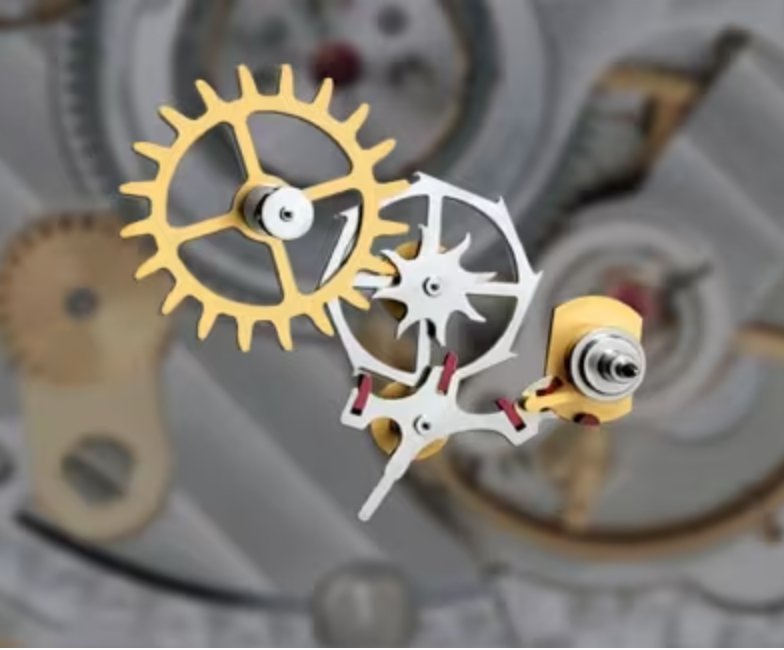
Take a mechanical watch and hold it to your ear. That ticking, that stubbornly regular beat, comes out of a minute organ almost nobody can name. It is called the escapement. It has governed the running of every watch for two and a half centuries, and it gave this publication its name. An English watchmaker, alone in his workshop, spent the 1970s rethinking it from the ground up. The Swiss industry took twenty years to deign to listen.
The mainspring’s constable
A mechanical watch keeps its energy in a coiled spring, the barrel. Left to itself that spring would unwind all at once, in a few seconds, like a released toy. So an intermediary is needed to let the reserve out in minute doses, at rigorously equal intervals. That intermediary is the escapement.
It performs two gestures at once. It holds the toothed wheel back and lets it advance only one notch, then another, which cuts the flow of time into identical fractions. And at each notch it returns a flick of energy to the balance, the small wheel that swings back and forth several times a second and acts as metronome for the whole. Deprive the balance of that push and it stops within a breath. All of a watch’s accuracy rests on the quality of that dialogue between the spring that pushes and the balance that counts. Get it right and it tells the time for decades. Miss it and it drifts.
Two centuries of friction
The mechanism fitted today to almost every mechanical watch has a name, the lever escapement, after the component that rocks between the wheel and the balance, and which French, seeing a ship’s anchor in it, calls the ancre. It is owed to the Englishman Thomas Mudge, who perfected it around 1754. Refined in the nineteenth century into what became known as the Swiss form, it conquered the world and never left it.
The lever has plenty to recommend it. It is robust, cheap, of proven reliability. One flaw, though, sits in its very nature. To pass the impulse to the balance, the teeth of the wheel slide over two small ruby pallets fixed to the lever. That sliding, that scraping of one surface against another repeated thousands of times an hour, wears the material and heats it. To calm it, a minute drop of oil is placed exactly at the points of contact.
That is where the real problem is tied. Oil does not last. It ages, thickens, migrates out of place, eventually dries. As it degrades the friction changes, the impulse deforms, and accuracy drifts slowly away from the right rate. Which is why a mechanical watch has to go back to the workshop every few years. It is stripped, cleaned, relubricated, and the counter starts again from zero. That servicing appointment is less a commercial ritual than a physical constraint. As long as a contact slides and calls for oil, the watch stays prisoner of that oil’s calendar.
For two hundred years the compromise was not seriously challenged. It was perfected without ever being overturned.
One Englishman against the obvious
George Daniels came out of no great manufacture. Born in London in 1926, died in 2011, he was one of the last men in the world able to carry a watch through from end to end, from case to smallest wheel, with nothing but his own hands. He built some twenty of them, almost all pocket watches, each shaped one by one in his workshop on the Isle of Man. Scholar as much as craftsman, he had spent his life studying the English masters of the eighteenth century and Breguet, of whom he became one of the finest connoisseurs.
It was through handling those old chronometers that a fixed idea took hold. Might there be a way to push the balance without the sliding that wears everything down? In the mid-1970s Daniels found it. He drew an escapement of a new kind, fitted it to one of his watches in 1976, then patented it in 1980. He gave it a name, the co-axial.
The principle can be told in a sentence. Rather than having the teeth scrape against the pallets, Daniels placed two wheels on the same axis, co-axial, hence the name, and redrew the geometry so that the impulse passes through an almost head-on push, with next to no sliding. The teeth push the balance instead of rubbing against it. The scraping vanishes exactly where it did the most harm. And when the friction goes, the need for oil goes with it. A watch with a co-axial escapement can, in principle, hold its rate far longer between services, since its accuracy no longer depends on a drop condemned to age.
Since Mudge’s lever, two and a half centuries earlier, no genuinely new escapement capable of one day going into production had appeared. One man, alone in a workshop, had just cracked the status quo.
Twenty years of closed doors
It remained to convince those who make watches by the thousand. Daniels knocked at the doors of the great Swiss houses, Patek Philippe, Rolex, the aristocracy of the trade. Everywhere, the same courteous wall. He was heard, he was admired, nothing moved.
not only would they not look at it, but they wouldn’t have understood it if they had looked at it
George Daniels, filmed interviews, Web of Stories, 2003
Disdain explains only part of that refusal. The real brake was industrial. Adopting the co-axial meant recasting production lines tuned to the micron over generations, retraining watchmakers and requalifying suppliers, committing capital to a geometry nobody yet knew how to machine in large series. The lever worked and it earned. Why overturn everything for a gain invisible on the dial, that no customer was asking for?
So Daniels waited. For years. The trigger came from somewhere other than a design office. A young man he had known as an apprentice, met again in a watch museum, joined Omega and eventually had the invention examined by those who could decide on it. In the mid-1990s the ruling came from the top. Nicolas Hayek, head of the Swatch Group to which Omega belongs, came down for industrialisation and committed the manufacture to a long and costly project, turning a craftsman’s drawing into a calibre that could be built by the thousand.
In 1999 Omega unveiled the result, an automatic movement with a co-axial escapement, the calibre 2500, housed in a De Ville watch produced in a limited series. For the first time since Mudge’s day, a radically new escapement left one man’s bench for industrial production.
Daniels had long grasped where the game was really being played.
once Omega had taken it up then everyone was very pleased to agree that it was worthwhile, but somebody important had to take it up before they would agree that it was of any practical use
George Daniels, filmed interviews, Web of Stories, 2003
The lesson
The story of the co-axial is a textbook case of how innovation travels, or refuses to travel, in a heritage industry.
There is first the paradox. In a sector that sells the long view and tradition, a technical novelty worries more than it attracts. Prestige watchmaking praises the unchanging, fidelity to the old gesture. An invention that renders the inherited solution obsolete disturbs a commercial narrative built on continuity. Daniels was not dealing with fools. He was dealing with perfectly rational players whose model preferred the comfort of what existed to the risk of a break.
Then comes the role of the independent, the great industry’s involuntary laboratory. It took a man with no production line to defend, no shareholder to reassure, no catalogue to protect, to dare to rethink the most untouchable organ of the watch. Manufactures excel at perfecting; they rarely invent in leaps. The sector has always needed its mavericks to bring it, ready-made, the leaps it does not dare risk itself.
What remains is the bitterest lesson for anyone who invents. Nearly twenty years passed between Daniels’s patent and the first production watch. That long delay has nothing to do with any flaw in the invention. It tells of the absence, for two decades, of an industrial sponsor powerful enough to absorb the cost of change and sure enough of itself to impose it. Genius delivers the drawing; the capital and the will of a large group turn it into a product. An innovation is not worth much on the day it is born. It takes its value on the day someone decides to build it.
That is perhaps the most useful moral for decoding contemporary watchmaking and its parade of miracle alloys and escapements presented as revolutionary. The right question, faced with each announcement, is not about the brilliance of the idea. It is about the interests at stake. Who, in the system, gains from this find finally leaving the workshop?
Key dates
| Date | Event |
|---|---|
| around 1754 | Thomas Mudge perfects the lever escapement, the future world standard |
| 1926 | Birth of George Daniels in London |
| Mid-1970s | Daniels designs the co-axial escapement ; he fits it to one of his watches in 1976 |
| 1980 | The co-axial patent is filed |
| 1981 | Publication of Watchmaking, his reference work |
| Mid-1990s | Under Nicolas Hayek, the Swatch Group commits Omega to industrialisation |
| 1999 | Omega launches the co-axial in series (calibre 2500, De Ville line) |
| 2000 | Publication of his autobiography, All in Good Time |
| 2011 | Death of George Daniels |
Sources: the writings of George Daniels, Watchmaking (1981) and the autobiography All in Good Time (2000)
the filmed interviews given by George Daniels to the Web of Stories collection (recorded in 2003)
the official Omega chronicle and the Swatch Group archives on the introduction of the co-axial escapement in 1999
the co-axial patent filed by George Daniels in 1980.
Research and writing assisted by Claude Code.