The industry that wins by selling less
In February, Morgan Stanley published its annual X-ray of Swiss watchmaking, the document the whole sector reads and nobody cites. The diagnosis came down to one word: contraction. A second year of decline, volumes at their lowest in decades, an ageing clientele. Six months later exports have picked up and the segment the report was burying shows the strongest growth of the year. We have gone back through that text line by line to separate what it establishes from what it wagers. Three articles, three questions these figures really put to Swiss watchmaking.
Two thermometers, one fever
We have to start with an awkwardness. The document that serves as the trade’s compass, the X-ray Morgan Stanley produces each year with the consultancy LuxeConsult, rests on almost no official figure. The houses that weigh the most publish nothing. Rolex, Patek Philippe, Audemars Piguet and Richard Mille are private companies, meaning they answer to no stock exchange and file no detailed results. Everything the report advances about them is estimation, reconstructed market by market, boutique by boutique. It is a sell-side analyst’s exercise, that of a bank writing first to inform investors, and which incidentally covers Richemont with a buy recommendation. You read this text with that fact in mind.
The report also measures something very specific: retail, sales to the end customer, at the price in the window. It is not the instrument of the Federation of the Swiss Watch Industry, the FH, which counts watches as they clear customs, ex-factory. Two thermometers, two temperatures. Confusing them means adding what a watchmaker banks to what a customer spends, two amounts that have never been the same. Our whole series sits in that gap. This first article settles on the profit side, where the report is most troubling.
Four houses, three quarters of the spoils
Here is the estimate that ought to keep any listed group executive awake. According to Morgan Stanley, the cumulative operating profit of Swiss watchmaking, what the trade calls the profit pool, the sum of what all the brands earn together, stood at around 7.9 billion francs in 2025, for an aggregate operating margin of about 22 per cent. Take that overall level and nothing finer: the profitability of a house taken on its own cannot be read in accounts it files nowhere, and we will not play at guessing it.
How are the spoils shared? Again according to Morgan Stanley, the four private houses named above account for roughly half the sector’s revenue, in the order of 51 per cent, but are estimated to take close to 76 per cent of the profit. Against them, the three large listed groups, Swatch Group, Richemont and LVMH, add up to around 41 per cent of revenue for barely 18 per cent of estimated profit. The report is indeed talking about listed companies, meaning present on the stock market, obliged to publish, scrutinised every quarter. So the same franc of sales does not produce the same franc of gain depending on which window it comes out of. A third of the industry, four names, carries off three quarters of the value.
That is already a small methodological bomb. Revenue, the line press releases lead with because it looks big in a headline, stops here telling us anything about the health of a brand. A house can sell a great deal and earn little. Another can sell half as much and take the pot. Put away the revenue league table: it describes a geography that no longer exists.
The profit hiding behind the window
Let us go down a level, still within Morgan Stanley’s estimates and never beyond them. Inside the listed groups themselves, the distribution stretches to apparent absurdity. The report estimates that Omega on its own generates more than the entire watch profit of its group, more than 100 per cent therefore, which implies that other brands in the same house consume what it produces. In the same family, Longines appears outright loss-making according to the analysis. Both of those statements are estimates, not audited accounts, and deserve to be read as such. One brand pulls the whole group while others weigh on the result, and the published net figure smooths that contrast to the point of near invisibility.
What this reveals about the listed model is almost cruel. These groups carry broad portfolios, with entry-level brands useful for volume and shelf presence, but whose contribution to profit can turn red when the market contracts. The private houses have only one signature to defend and concentrate their forces on a single point. That internal imbalance deserves better than a paragraph, and the Omega case is its most spectacular example. We devote the second part of this series to it.
Selling less to be worth more
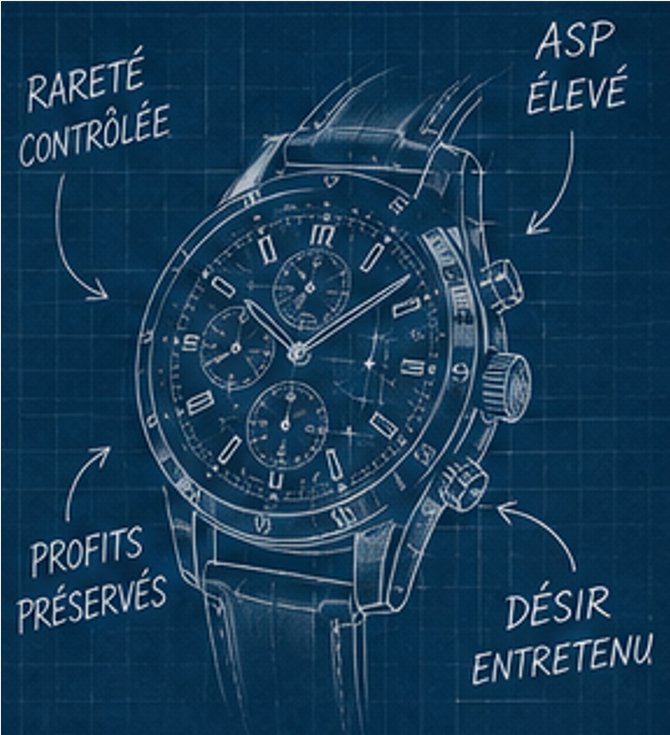
There remains the question that makes this reading worth something. Why the gulf between what is sold and what is earned? The answer lies in a word the sector prefers to dress in romance: scarcity. A house that delivers fewer pieces than the market asks for manufactures desire, holds its average selling price, the ASP in the jargon, meaning the average price banked per watch, and has no need to discount to clear stock. Value is no longer measured by tonnage produced but by the ability to control the tap.
It is a complete reversal of classic industrial logic, the one that rewarded volumes and market share. In the new regime the report implicitly describes, market share in units becomes a misleading indicator. You can lose it and grow rich. You can gain it and grow poor. The four private houses have made discipline on quantities a financial asset in its own right, as precious as a manufacture or an in-house movement.
What this reveals
The February report records a shift that the crisis of the last two years has only accelerated. As long as the market was rising, everyone earned and the profitability gap stayed a subject for insiders. The contraction has made the structure visible: when the tide goes out, you see who controlled their scarcity and who was subject to their volumes. For a listed group the lesson is uncomfortable, because the stock market values revenue growth first, the very metric this report disqualifies as a signal of health.
A cool head is needed, though, on the nature of these figures. They are 2025 retail estimates, the photograph of a moment, taken by a bank that is not neutral and that reconstructs what the houses keep quiet. A photograph is not a film. And that is where our series gets up from its chair: six months after this snapshot of contraction, Swiss customs delivered the facts. On 21 July the FH confirmed a first half of 2026 back in growth, carried by a segment the report had given up for dead. The strongest growth of the year, a rise of 23.8 per cent, sat in volume, in numbers of units, on mechanical watches whose ex-factory price stays under 500 francs, meaning roughly under 1,250 francs in the window. Meanwhile the supposed heart of accessible luxury, the 500 to 3,000 franc band, fell 5.7 per cent by value. The photograph says one thing, the film is already telling another. We will come back to it.
Sources: Morgan Stanley Research and LuxeConsult, “Swiss Watcher” report, February 2026 (2025 retail estimates)
Federation of the Swiss Watch Industry (FH), statement on Swiss watch exports at mid-2026, 21 July 2026, and monthly commentary for June 2026, fhs.swiss
public financial communications of Swatch Group, Richemont and LVMH.
Research and writing assisted by Claude Code.