The quartz crisis: how Swiss watchmaking nearly died of its own invention
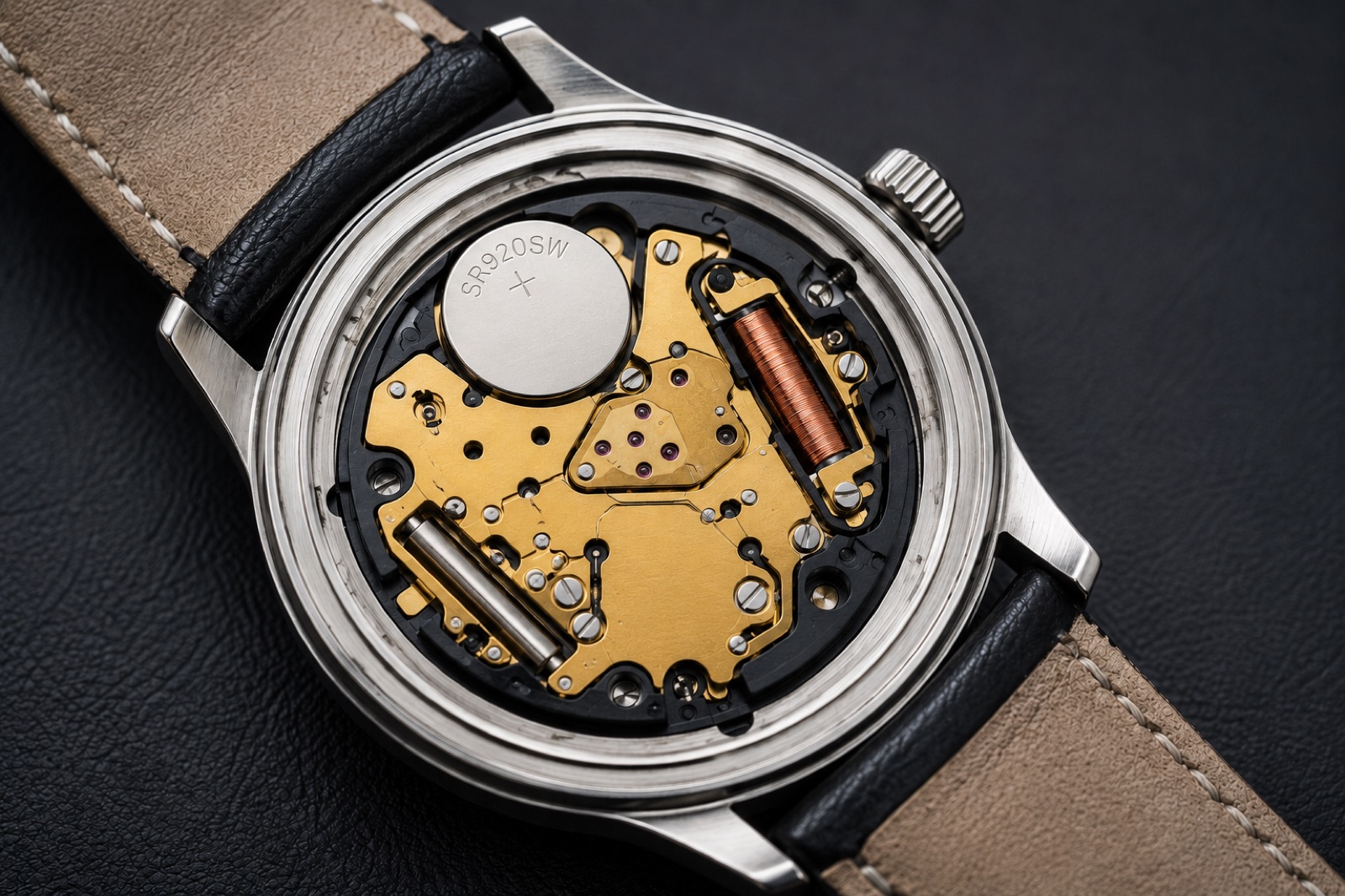
Fifteen years were enough for Swiss watchmaking, sovereign over time for two centuries, to lose two thirds of its jobs. A convenient culprit was named for a long while, a thin sliver of quartz out of Japan. The truth is more troubling, and it looks oddly like the one whole industries are living through today in the face of artificial intelligence.
Christmas Day 1969, Tokyo
On 25 December 1969, a few Tokyo shop windows displayed an object of ordinary appearance. It was the Seiko Quartz Astron. One hundred examples, all in gold, priced at 450,000 yen each, roughly the price of a car. Inside a week, not one was left.
Under the case a small revolution was playing out. Where traditional mechanics swing a balance a few times a second, a quartz crystal vibrates more than eight thousand times in the same interval under an electric current. Accuracy made a leap that two hundred years of craft had never allowed. That Christmas Day, without fanfare, Switzerland had just been left behind.
Neuchâtel’s well-kept secret
The most awkward detail of the affair is the one most readily forgotten. The Swiss held exactly the same technology. Before the Japanese.
As early as 1962, some twenty manufacturers had joined forces to fund a shared laboratory at Neuchâtel, the Centre électronique horloger. By July 1967 their engineers were already running the Beta 1, one of the very first quartz calibres in the world. The production movement that came out of it, the Beta 21, went on sale in 1970, barely a few months after the Japanese Astron.
Switzerland did not miss quartz through ignorance. It pushed quartz aside out of pride. Electronics threatened everything it took pride in: the watchmaker’s hand, the tradition, the thousands of people trained at the bench. The Beta 21 was launched half-heartedly, too expensive, without conviction, and then forgotten. Meanwhile Seiko, Citizen and Texas Instruments in the United States were turning out quartz by the million and pulverising prices.
The collapse
The fall came, and it was brutal. In a dozen years, Swiss watchmaking employment dropped from around 90,000 posts to 30,000. The companies themselves fell from 1,618 in 1970 to 861 in 1980, and the bleeding went on after that.
By 1980 the verdict was beyond argument: four quartz watches out of five came out of Japanese factories. The country of Geneva and the Vallée de Joux stood with its arms at its sides, watching a market it had invented itself prosper elsewhere. Its two flagships, ASUAG and SSIH, the latter home to Omega and Tissot, were dying on a drip from the banks.
One man’s bet
In 1983 the bankers summoned a consultant of Lebanese origin, Nicolas Hayek, to the bedside, with a brief that read like a funeral oration: organise the break-up of ASUAG and SSIH. Hayek listened, then told them the exact opposite. Swiss watchmaking could still win, provided it stopped fighting on the enemy’s ground.
Years later Hayek would come back to the absurdity of that moment. Some banks were considering selling off the assets of ASUAG and SSIH to the Japanese, convinced, as much of the country was, that the Swiss no longer knew how to make anything and that the future lay in services.
His plan came down to two moves. First, bring the two dying giants together into a single company, the Société suisse de microélectronique et d’horlogerie, to put order back into a scattered industry. Then draw a weapon nobody was expecting: the Swatch. A quartz watch, plastic, cheap, but sold as a fashion accessory, colourful, cheerful, a second watch collected for pleasure. No chase after Seiko on price or accuracy. Hayek moved the fight onto ground where Switzerland still had something to say: emotion.
I understood that we were not just selling a consumer product, or even a branded product. We were selling an emotional product.
Nicolas Hayek, Harvard Business Review, 1993
The success went beyond anything anyone had dared imagine. In five years the group became the richest watchmaker on the planet. It took the name we know it by, Swatch Group, and today it rules over Omega, Longines, Tissot, Breguet and Blancpain. In the final irony, the profits of the little plastic watch would fund the rebirth of mechanical haute horlogerie, the very thing quartz was supposed to bury.
The lesson
This story is too quickly reduced to a fable about the machine that devours a trade. That misses the savour of it.
What very nearly killed Swiss watchmaking was not quartz, it was the refusal to look at quartz squarely. The Swiss held the technology before anyone else. They put it in a drawer because it contradicted the idea they had of themselves. Owning the innovation protects nobody; it still takes the nerve to seize it before someone else does it in your place.
The recovery tells a second truth. Switzerland did not save itself by beating Japan at its own game but by changing the game, selling desire while the competitor sold function. Today’s luxury watch, the one that costs the price of a flat and is handed down like a jewel, is the child of that strategic pirouette far more than of any feat at the bench.
The question it leaves us has not aged a day. When disruption knocks, it can be denied in the name of what you believe you are, or made the setting for a new act. Swiss watchmaking chose late. It very nearly chose too late.
Key dates
| Date | Event |
|---|---|
| 1962 | The Centre électronique horloger is founded at Neuchâtel |
| July 1967 | The Swiss Beta 1 calibre becomes operational |
| 25 December 1969 | Seiko launches the Quartz Astron, the first commercial quartz watch |
| 1970 | The Swiss Beta 21 goes on sale, and fails |
| 1970 to 1980 | Swiss watch companies fall from 1,618 to 861 |
| 1973 to 1985 | Swiss watchmaking employment drops from around 90,000 to 30,000 |
| 1983 | Hayek merges ASUAG and SSIH and launches the Swatch |
Sources: Wikipedia (Quartz crisis
Centre électronique horloger)
Seiko, official history of the Quartz Astron
Swatch Group and Omega, official histories
Harvard Business Review, “Message and Muscle”, 1993.
Research and writing assisted by Claude Code.