Seiko and the Japanese ascent: the rival nobody took seriously
There is a line nobody ever found signed, but which hung in the corridors of the Vallée de Joux in the early 1960s: Japanese watches are ironmongery. Cheap, adequate, soulless. They were tolerated in Asian markets the way a loud cousin is tolerated at a wedding. A decade or so later that ironmongery had taken the top places in the Swiss observatory trials, pushed Neuchâtel to shut up shop, and was releasing the first quartz watch in history. A look back at a trajectory nobody in Biel or Geneva saw coming. And at the precise reason it was not seen.
A watchmaker nobody was watching
The story begins in 1881, in Tokyo. Kintaro Hattori was twenty-two when he opened a shop selling and repairing watches. In 1892 he bought a derelict factory and founded Seikosha, his manufacture. The name came later, in 1924, set on a dial for the first time: Seiko, a word that says both precision and success.
Hattori was no dreamer. His motto, kept by the Seiko Museum Ginza, belonged as much to commercial art as to philosophy.
Merchants must be one step ahead of others, but only one. If they take too many, they will be seen as prophets, too far removed from reality. A merchant must not be a prophet.
Kintaro Hattori, quoted by the Seiko Museum Ginza
As early as 1913 Seikosha launched the Laurel, the first Japanese wristwatch, at a time when the whole world was barely beginning to move from the pocket to the wrist. The house’s real bet, though, was less visible. Where Swiss watchmaking rested on a dense fabric of subcontractors, each specialised in one component, Seiko built the exact opposite: an almost total vertical integration, assembly as well as the casting of jewels, mainsprings as well as tooling, all under one roof. Better still, the company organised its own internal rivalry. Two factories, Suwa Seikosha in the mountains of Nagano and Daini Seikosha in Tokyo, developed competing movements in parallel. They were made to race each other. That engine, domestic emulation, was soon going to leave Japan.
Rebuilding, twice over
September 1923. The Great Kanto earthquake laid waste to Tokyo, and the fires finished what the tremors had spared. The Seikosha factory, the shop, Kintaro Hattori’s house: all burned. In the rubble lay some 1,500 watches and clocks customers had left for repair. Lost.
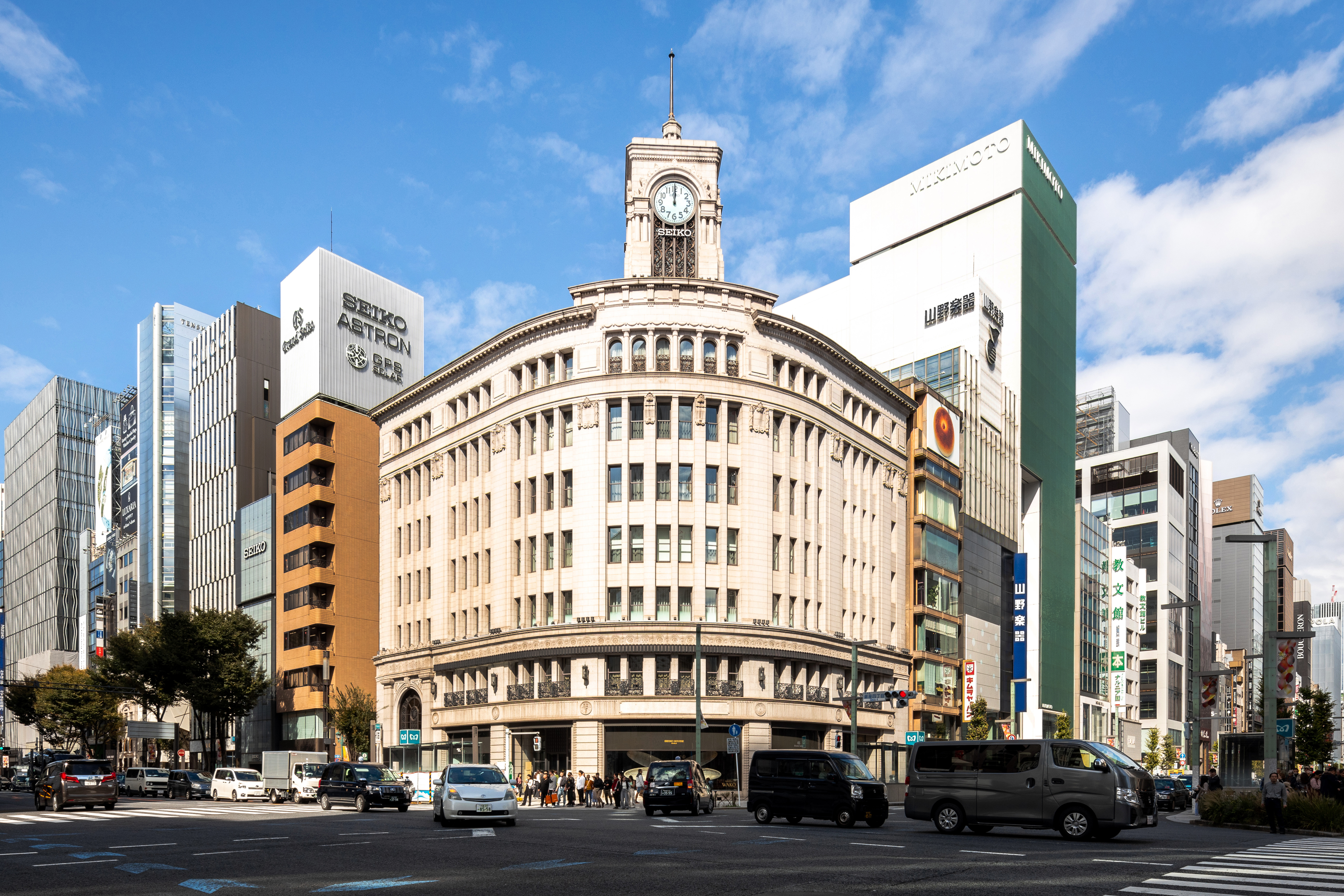
Hattori was sixty-two. Four days after the disaster he announced the rebuilding. Then he put a notice in the newspapers: every customer whose watch had vanished in the fire would receive an equivalent new one, at his own expense. He was under no obligation, and the whole city remembered the gesture. By December production had resumed, and it was from that restart that the name Seiko was born, under a brand new mark. In 1932 the watchmaker’s tower rose in Ginza, where it still stands watch.
Kintaro Hattori died on 1 March 1934, aged seventy-three, and the company stayed in the family. Then came the war years: the factory turned to military instruments, cockpit and armoured vehicle equipment, before bombing destroyed part of it. Once again everything had to be rebuilt from the ground up. A house that had rebuilt twice in one generation had learned what its competitors did not know: industrial discipline survives ruins better than stock does.
Marvel, 1956: the manufacture learns to think for itself
The post-war years are the real turning point, and it carries a name that sounds like an advertisement: Marvel. In 1956 the engineers of Suwa Seikosha presented the first Seiko movement conceived entirely in house, drawn from a blank sheet, without leaning on a copied Swiss ébauche. The break is less spectacular than a Grand Seiko, but deeper. For the first time the house stopped copying an ébauche and drew its own architecture, its own compromises of accuracy.
The rest followed fast. In 1958 the Lord Marvel became the brand’s spearhead, easier to read, more resistant to shock. In 1959 the Gyro Marvel introduced the first automatic movement designed and built in house, driven by a device called the Magic Lever, a pawl winding system so efficient that it still equips calibres today. In three years Suwa had acquired the three skills it lacked: designing from nothing, industrialising, winding without human intervention.
It is that accumulation, and not a flash of genius, that makes December 1960 possible. The Grand Seiko did not fall from the sky. It came out of a workshop that had burned twice, rebuilt twice, and spent the previous decade relearning its trade without a net.
Grand Seiko, 1960: the head-on challenge
On 18 December 1960, Seiko presented a watch whose intention was anything but modest: the Grand Seiko. The name reads like a declaration. The ambition set out by the Suwa engineers was to build the ideal practical watch, cut for three functions pushed to their maximum: accuracy, reliability, legibility.
Under the dial, the calibre 3180, hand wound, forty-five hours of power reserve, regulated between plus twelve and minus three seconds a day. The figure matters, because it carries a new claim. The first Grand Seiko was the first Japanese watch to meet the standards of the Bureaux Officiels de Contrôle de la Marche des Montres, the Swiss benchmark of certified accuracy. In other words, Japan had come to find Switzerland on its own ground, under Swiss rules, and it passed the examination.
In Geneva nobody flinched. A watch that ticks the boxes of a chronometer is still one watch among thousands. The contempt, at that stage, was not even hostile. It was distracted. That is often the most dangerous form.
Neuchâtel, where nobody could cheat
There was one place then where accuracy was measured without indulgence: the chronometry trials of the Neuchâtel and Geneva observatories. Every year the manufactures sent their sharpest movements, often exceptional pieces regulated by hand, tested for weeks in several positions and at different temperatures. A ranking came out of it. The prestige attached to it fed the whole communication of the sector. It was the unofficial world championship of mechanical watchmaking.
In 1964, Suwa and Daini Seikosha entered the mechanical wristwatch category at Neuchâtel for the first time. The result was a slap. 144th place for one, with a score of 7.97 points, 153rd for the other. Neither passed. The Japanese went home humiliated, with their readings and one fixed idea.
What they did next is the part Switzerland should have studied closely. They took everything apart: high-frequency balances, the theory of regulation, the behaviour of hairsprings. Every edition, they climbed. In 1967, barely three years after the debacle, Seiko took the second and third series prizes in the company awards category, and dominated the pocket chronometer contest.
Then came 1968. That year Suwa Seikosha presented itself at the Geneva observatory and took fourth to tenth place in the mechanical ranking, its best wristwatch posting 58.19 points, an absolute record that erased everything before it. The competitor nobody was watching found itself at the top table, four years on from 144th place.
The contest that chose to end
What followed reads like an admission. After 1968 the wristwatch contest did not reopen. Officially, the Swiss observatories suspended the trials and set up a working group. Unofficially, something had broken.
Two forces came together. One had a Japanese name. The other was about to sweep everything away: quartz. In Geneva that year all three steps of the podium had gone to quartz movements, ten times more accurate than the best hand-regulated mechanics, Swiss as well as Japanese. The question was becoming awkward. What is the use of a championship of mechanical accuracy when accuracy is now decided elsewhere, an order of magnitude above? The competition was closed rather than answered. Seiko was denied the chance to defend its 1968 result, and the observatories left behind a silence of several decades. Losing is not always a matter of being beaten. Sometimes you win, and discover the referee has put the chronometers away.
The Astron, the extra step Hattori allowed himself
On 25 December 1969, in a Tokyo department store, Seiko unveiled the Quartz Astron 35SQ, the first commercially sold quartz wristwatch in the world. Stated accuracy: around one minute a year, an order of magnitude above the best mechanics.
The project, known internally as 59A, had started back in 1959, a decade of research led by the Suwa teams under Tsuneya Nakamura. In 1968 the president, Shoji Hattori, heir to the founder’s line, had demanded a market launch within the year. The price said both the feat and its limits: 450,000 yen, the equivalent of a car. Only some twenty examples were produced before the end of December, a hundred sold soon after, all in gold, all in Japan.
The object was prohibitively expensive and barely circulated. The idea it carried was not. The slogan Seiko would attach to its descendants said the essential: one day, all watches will be made this way. Kintaro Hattori wanted one step ahead, only one. On this occasion his company had taken several, and the Swiss sector needed ten years to understand how many.
The lesson
Contempt has a mechanism, and this story exposes it better than any other.
Switzerland did not underestimate Seiko out of pure arrogance. It did so for a perfectly rational reason: in 1960 the Japanese watch was less desirable, cheaper, without patina or prestige. Judging a competitor on what it is worth today is the most natural reflex there is. It is also the trap, because a competitor’s level counts for far less than its slope. How fast is it learning? From 144th to 4th in four years, Seiko’s slope was shouting the answer. Nobody read it as strategic data. It was read as an anecdote.
This is the classic pattern of disruption from below, the one Clayton Christensen would theorise much later. The attacker comes in through the least prestigious segment, the one the leader happily abandons because there is little to earn there. It refines its processes, climbs the range, and by the day it meets the incumbent, the incumbent has no time left to react. Seiko’s vertical integration, its organised internal rivalry, its obsession with objective measurement: all of them invisible advantages as long as you look only at the finished product and its price tag.
The scene replays constantly. A free, shaky piece of software the professionals mock, and which then replaces them. An artificial intelligence model that stammers in 2022 and drafts contracts two years later. The cheap competitor that learns fast is the hardest threat to take seriously, precisely because taking it seriously means believing a curve rather than your own eyes. Neuchâtel preferred to close the contest than accept the verdict. That is human. It is also the definition of a missed opportunity.
Key dates
| Date | Event |
|---|---|
| 1881 | Kintaro Hattori opens his watch business in Tokyo |
| 1892 | Founding of the Seikosha manufacture |
| 1913 | Laurel, the first Japanese wristwatch |
| Sept. 1923 | The Kanto earthquake destroys the Seikosha factory ; Hattori replaces the 1,500 lost customer watches at his own expense |
| 1924 | First watch carrying the Seiko name |
| 1932 | The Hattori tower opens in Ginza |
| 1 March 1934 | Death of Kintaro Hattori, aged 73 ; the company stays in the family |
| 1956 | Seiko Marvel, first movement conceived entirely in house |
| 1958 | Lord Marvel, the brand’s new spearhead |
| 1959 | Gyro Marvel, first in-house automatic, fitted with the Magic Lever |
| 18 Dec. 1960 | First Grand Seiko, calibre 3180 |
| 1964 | Debut at Neuchâtel: 144th and 153rd places in the mechanical category |
| 1967 | 2nd and 3rd series prizes ; domination of the pocket chronometers |
| 1968 | At Geneva, Seiko takes 4th to 10th mechanical places, record of 58.19 points |
| after 1968 | Suspension of the Swiss observatory wristwatch trials |
| 25 Dec. 1969 | Launch of the Quartz Astron 35SQ, at 450,000 yen |
Sources: Seiko Museum Ginza (company history and history of Kintaro Hattori, section on the Swiss observatory chronometry trials, entry on the first Grand Seiko of 1960)
Seiko Watch Corporation, official file on the 1969 Quartz Astron and its genesis (project 59A, led by Tsuneya Nakamura)
published results of the Neuchâtel and Geneva observatory chronometry trials for the 1964 to 1968 editions.
Research and writing assisted by Claude Code.