The Moon watch: how a NASA procurement round made the Speedmaster a legend
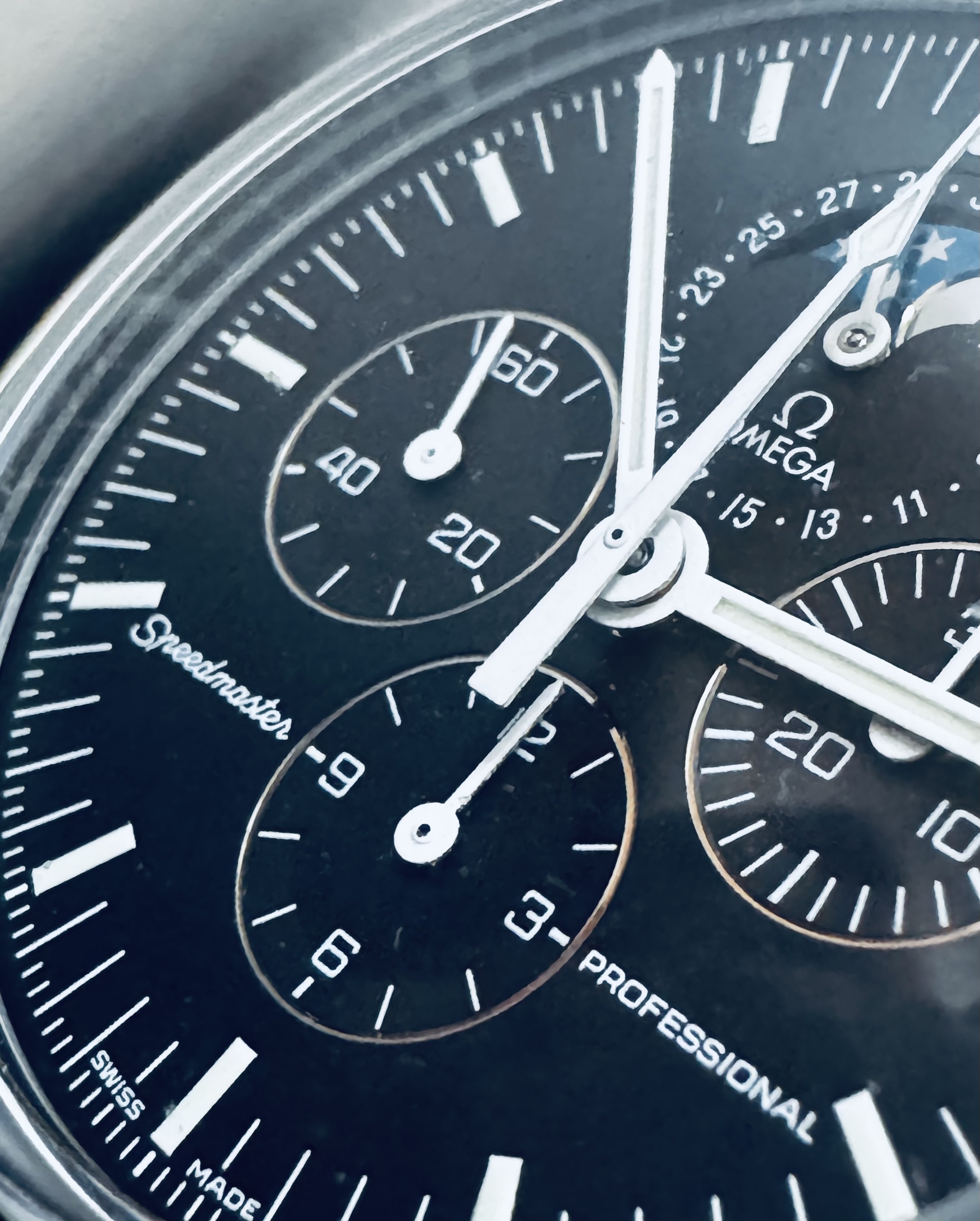
There are the stories brands tell, and there is how they actually begin. The Speedmaster’s opens on a scene without grandeur. In 1964 a NASA engineer received a task that looked trivial against the stakes: find a watch capable of accompanying men to the Moon. He did not summon the great watchmakers to a secret laboratory. He put out a request for quotes to distributors, and the chronographs that went on the test bench were plain production models, bought with no preparation and no favours. That prosaic starting point would produce the most solid advertising narrative in all of watchmaking.
One engineer, a list, a few watches
The man’s name was James Ragan. In 1964 NASA put him in charge of qualifying a chronograph for its crewed missions. The rule he set himself was simple and merciless: astronauts already took their own watches along, but equipment committed to an official flight had to be tested and certified like any other onboard instrument.
Ragan therefore sent a request for quotes to about ten manufacturers. Only four replied: Rolex, Longines-Wittnauer, Hamilton and Omega. Hamilton eliminated itself by submitting a pocket watch, beside the point for a gloved wrist. That left three production chronographs, with no prototype and no special preparation: the Longines-Wittnauer reference 235T, the Rolex reference 6238, and the Omega Speedmaster reference 105.003. No favours. Catalogue watches, taken as they came.
Eleven tests, one survivor
What Ragan then put them through was no ordinary quality check. Between October 1964 and March 1965, each watch went through eleven tests designed to reproduce, then exceed, the hell of a space flight: heat at 71°C held for hours before being pushed higher still, freezing cold, a deep vacuum, air humidity close to saturation, shocks and vibration, violent acceleration, brutal decompression and a pure oxygen atmosphere.
The two rivals did not survive the heat. The Longines-Wittnauer’s crystal deformed and broke the seal of the case, the Rolex’s movement eventually stopped. The Speedmaster held. It came out battered but alive, still able to tell the time. On 1 March 1965 NASA recorded its qualification in an official report. The watch was declared fit to equip American crewed flights. The wording that sealed that verdict would later be engraved on the back of every example, where it can still be read today.
Flight-qualified by NASA for all manned space missions.
Caseback engraving of the Speedmaster Professional, after the NASA qualification verdict, 1965
Three months later, on the first American spacewalk, Ed White floated above the Earth with a Speedmaster strapped over his suit. The catalogue watch had become mission equipment.
What Apollo 11 actually wore
The legend says the Speedmaster went to the Moon. That is true, but the detail is tastier than the slogan. On 20 July 1969, when the lunar module landed, its onboard electronic timer failed. Neil Armstrong left his own Speedmaster inside the module, as a backup for the failed clock. He went down the ladder and set foot on the Moon with no watch on his wrist.
So it was Buzz Aldrin, following him a few minutes later, who carried his onto the lunar surface. The first watch to walk on the Moon was not the first man’s but the second’s, through the accident of a broken timer. The irony does not stop there. Armstrong’s watch has rested since 1973 at the National Air and Space Museum in Washington. Aldrin’s vanished in 1971 during its transfer to that same museum. It has never been found. The most mythical object in the history of watchmaking is a lost one.
Fourteen seconds
Myth feeds on images, but this one was forged once and for all on a fact, in April 1970. Aboard Apollo 13, the explosion of an oxygen tank turned a flight to the Moon into a race for survival. Stripped of power, the crew had to shut down most of their systems, digital timers included. To bring the craft back into the atmospheric re-entry corridor, an engine had to be fired manually for exactly fourteen seconds. Too little, and the craft would bounce off the atmosphere and head back into the void. Too much, and it would burn up in it.
Jack Swigert timed those fourteen seconds on a mechanical, hand-wound Speedmaster, indifferent to the general electrical failure. On 17 April the three men splashed down alive. On 5 October 1970 the astronaut Thomas Stafford presented Omega with the Silver Snoopy Award, the distinction by which NASA crews salute a contribution to flight safety. The accompanying certificate is signed by the three survivors themselves, Lovell, Swigert and Haise. For a brand, no campaign could have bought that.
The badge and the myth
There is the raw material. It is real, verifiable, engraved in steel and recorded in NASA’s archives. What Omega made of it belongs to another talent. The brand held a true story, and never let go again. A nickname first, the Moonwatch, repeated until it became a proper noun. A second line engraved on the back, turning a dated fact into a permanent identity.
The first watch worn on the Moon.
Caseback engraving of the Speedmaster Professional
Since then the Speedmaster has changed very little, and that is deliberate. Where the industry renews its models to create desire, Omega understood that the value of this one lay precisely in its stillness. Altering the 1969 watch would betray what makes it desirable. The product has become the reliquary of its own story.
The lesson
The Speedmaster’s story says something simple and often forgotten about this sector: a real use weighs more than a thousand arguments. No marketing department would have dared write a script as improbable as a timer failing on the Moon or an engine fired to the count of a wristwatch to save three men. The brand did not manufacture those moments. It merely happened to be there, on the wrist, the day they occurred, because a meticulous engineer had judged it trustworthy five years earlier.
What remains is the vertiginous part of the affair. This tool watch, built to be legible and robust, a plain production model off an assembly line, is today a status object bought for what it says far more than for what it measures. The functional badge has become a social sign. That is the secret journey of many objects that become desirable: they begin by being useful and end by meaning something. The Speedmaster managed both, and never had to choose.
Key dates
| Date | Event |
|---|---|
| October 1962 | Wally Schirra takes his own Speedmaster on the Mercury Sigma 7 flight |
| 1964 | NASA quietly puts out a request for quotes for a qualified chronograph |
| Oct. 1964 to March 1965 | Eleven endurance tests ; only the Speedmaster survives |
| 1 March 1965 | NASA qualification report |
| June 1965 | Ed White wears the Speedmaster on the first American spacewalk |
| 20 July 1969 | Buzz Aldrin’s Speedmaster, first watch worn on the Moon |
| April 1970 | Apollo 13: a Speedmaster times the fourteen-second engine burn |
| 5 October 1970 | NASA presents Omega with the Silver Snoopy Award |
Sources: NASA, official history of the Apollo programme and Manned Flight Awareness / Silver Snoopy Award
Omega, official chronicle of the Speedmaster (1965 qualification, Apollo 11, Apollo 13)
Smithsonian National Air and Space Museum (Neil Armstrong’s chronograph, Apollo 11)
caseback engravings of the Speedmaster Professional.
Research and writing assisted by Claude Code.