Submariner and Fifty Fathoms: the watches that ended up leaving the water
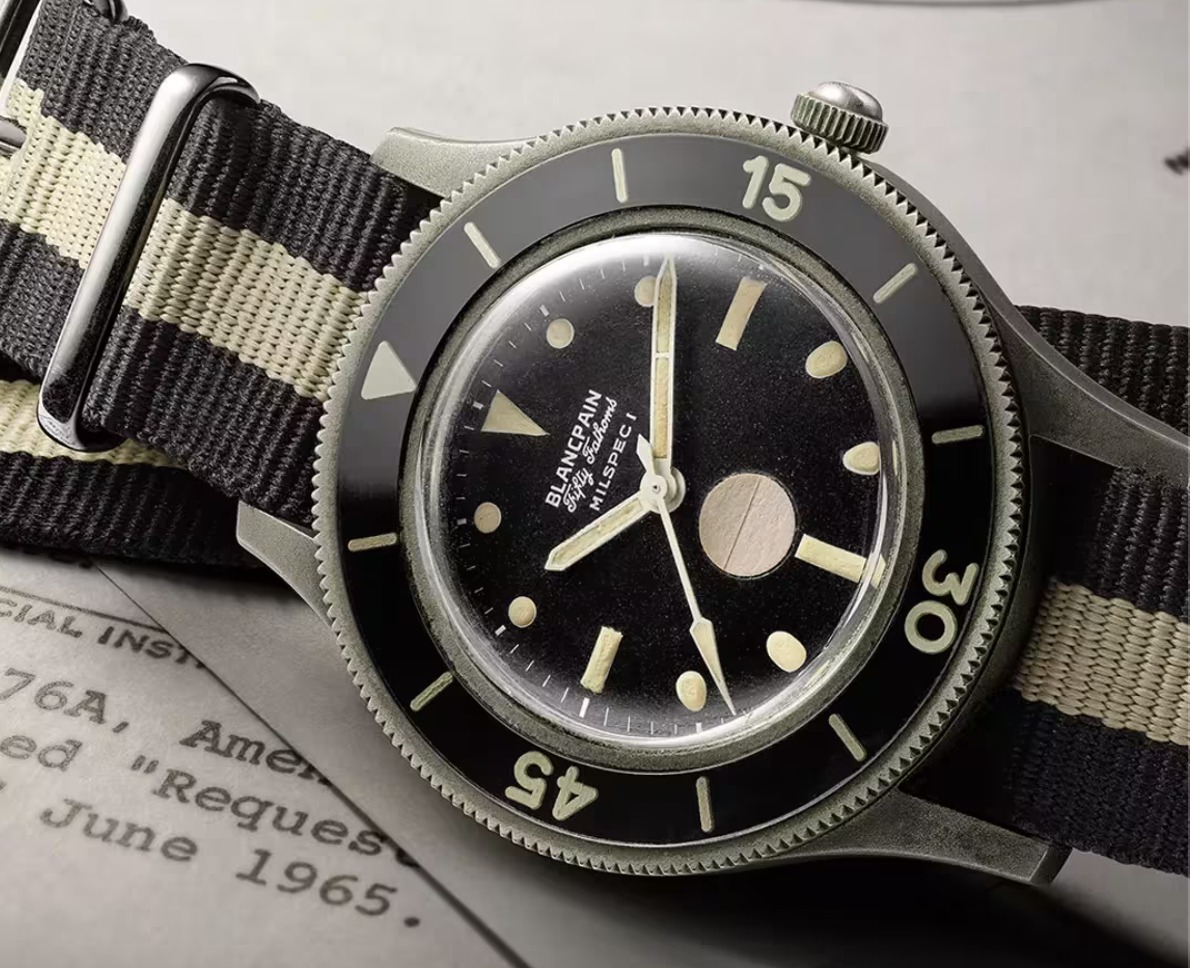
Two watches born the same year, 1953, for a survival mission under the sea. Seventy years later they circle the wrists of executives who will never wet a strap. The story of a function that became a language.
1953: two answers to the same danger
To grasp what was at stake in 1953, you first have to approach the fear surrounding it. When a diver breathes compressed air at depth, nitrogen dissolves in the blood. Come up too fast and that gas returns to bubbles, like a fizzy bottle opened all at once. That is decompression sickness, running from joint pain to paralysis and sometimes death. The defence lies in strict discipline: measure the time spent at the bottom, hold the stops on the way up. Underwater, without a reliable watch, a diver gambles a life with no clock.
Watchmaking already knew, in theory, how to build a waterproof watch. Rolex had shown it as early as 1926 with the Oyster, a case sealed by a bezel, a back and a crown screwed against the middle case, the way a jar is closed. The founder Hans Wilsdorf chose that name, the oyster, because in his view his watch could stay underwater indefinitely without damage to its elements. The following year, in 1927, a young British typist, Mercedes Gleitze, swam the Channel, the first British woman to complete it. A hoax by another swimmer cast doubt on her feat, and she decided to do it again to prove it. It was on that vindication swim that she wore an Oyster hung round her neck. After more than ten hours in freezing water, exhausted, she was hauled aboard the escort boat before reaching the coast. The watch came out intact and still keeping time. Rolex bought a full front page in the Daily Mail to proclaim the watch that had defied the Channel. The proof was made. It remained to turn it into an instrument.
Two houses took the step the same year. The temptation would be to crown a winner in the race for precedence. The archives of the two brands do not allow a clean verdict, and the question matters less than one might think. What is striking is the convergence: in 1953 Rolex launched the Submariner and Blancpain the Fifty Fathoms, two objects conceived by divers, for divers.
The Submariner came out water-resistant to 100 metres, with a twin-sealed screw-down crown and a graduated rotating bezel. That bezel is the real brain of the affair. The diver lines the marker up with the minute hand on entering the water, then reads the elapsed time at a glance. Rolex entrusted its watch to the French diver and underwater photographer Dimitri Rebikoff, who put it through a hundred and thirty-two dives along the Côte d’Azur, down to sixty metres. His 1953 report declared it indispensable to any dive in self-contained equipment. A year later, water resistance went to 200 metres.
Combat swimmers write the specification
The Fifty Fathoms came out of a military order. After the war the French Navy decided to raise a corps of combat swimmers, assault divers charged with clandestine underwater missions. The matter was handed to Captain Robert Maloubier, a former agent of the British special services, and Lieutenant Claude Riffaud. The two men looked for a watch equal to their dives and found none. So they wrote the specification with their own hands: large black dial, luminous markers and hands for reading in darkness, protection against magnetism, water resistance, and that rotating bezel which turns into an obsession.
They approached the French watchmaker LIP first. According to the account published by Blancpain itself, the answer was scathing: dive watches had no future. In the end a small manufacture at Le Brassus, Blancpain, and its head Jean-Jacques Fiechter, himself a keen diver, agreed to build the instrument. Fiechter was already working on a watch of the same kind for his own use. In 1953 the Fifty Fathoms was delivered to the combat swimmers. Its name states its promise: fifty fathoms, the fathom being an old marine unit of about 1.83 metres, so a little over 91 metres of guaranteed depth.
On these watches appeared a refinement that would become the signature of the genre: the bezel designed to pivot in one direction only. The principle has the beauty of simple things. If a knock moves the bezel by accident, it can only shorten the time shown, never lengthen it. The diver will believe there is less air left than there really is, and will come up sooner. When the error comes, it always leans on the side of life.
Cinema, the trench and the wider public
The following decade turned these specialists’ tools into objects of desire. Recreational diving exploded, carried by the spread of the aqualung. And cinema seized on it. In 1956 Jacques-Yves Cousteau and the young Louis Malle won the Palme d’Or at the Cannes Festival for The Silent World, the first major film to reveal the sea floor in colour. It took the documentary Oscar the following year. Blancpain recounts that the Calypso crew dived equipped with Fifty Fathoms. Millions of viewers discovered underwater adventure, and on the wrists of the explorers, a watch.
Rolex for its part played the card of extreme feats. On 23 January 1960 an experimental example named the Deep Sea Special went down into the Mariana Trench, fixed to the hull of the bathyscaphe Trieste, carrying the oceanographer Jacques Piccard and the American lieutenant Don Walsh. Depth reached: 10,916 metres, under a pressure of more than a tonne per square centimetre. The watch came back intact. Piccard sent Rolex a telegram that has stayed famous:
Happy to inform you that your watch is as precise at 11,000 metres as at the surface.
Jacques Piccard, telegram to Rolex, 1960, translated from the French
The argument has nothing utilitarian left for ordinary wrists. Nobody will ever go there. What remains is a story, a mythology of reliability bought over the counter.
When the tool loses its job
The 1970s and 1980s sealed the shift. First because technology caught up with the watch. The arrival of electronic dive computers, calculating nitrogen saturation and stops in real time, made the rotating bezel superfluous for the professional. The mechanical instrument lost its reason to exist at the precise moment it gained a status.
Then because the watch industry was going through its worst storm. The quartz crisis, those accurate and cheap Japanese electronic watches, flattened Swiss mechanics. Blancpain came close to disappearing before being revived in the early 1980s by Jean-Claude Biver and Jacques Piguet, who bet against the current on the traditional mechanical watch when everyone was declaring it dead. The Fifty Fathoms hibernated, until the full resurrection of the collection in 2007. The Submariner never stopped, and came out of the crisis transfigured into an icon.
Here is the paradox of the 1990s and 2000s. The less the dive watch is used for diving, the more it sells. It becomes a social uniform, recognisable among thousands, offered in steel, in gold, up to versions set with stones that will never see the sea. The bezel that used to save lives now signals a belonging. It is worn in the office, in a suit, under a shirt cuff. Decompression sickness is no longer a risk. It has become an anecdote to tell.
The lesson
The story of the dive watch is a textbook case of what marketing calls, when it dares name it, the transfer of value. A real, dated technical function, measuring a safety time underwater, turned into a pure sign. The process is neither an accident nor a betrayal. It follows a traceable mechanism the watch sector has replayed a thousand times since.
The function creates the legitimacy first. Nobody would have bought a Submariner out of pure snobbery had it not first served, genuinely, real divers. Proof of use is the foundation. The narrative of the feat then takes over and extends the function far beyond its concrete usefulness. The Mariana Trench, the Calypso, the French combat swimmers: those stories are worth something because they are true, and they end up becoming the product being sold. Then technology makes the function obsolete, and the object does not die for all that. It moves up-market. Relieved of its job, it becomes a sign, and the sign is paid for more dearly than the tool.
Which is why a brand sitting on such a heritage holds an asset almost impossible to copy. A rotating bezel is imitated in a few months. Seventy years of dives, a telegram from Piccard or a Palme d’Or cannot be manufactured retroactively. Luxury watchmaking lives today on that narrative income. The lesson for any brand dreaming of entering this game has something brutal about it: status is not decreed, it settles like sediment, one dive after another. You have to have served some purpose first in order, one day, to serve none at all and sell for more than ever.
Key dates
| Date | Event |
|---|---|
| 1926 | Rolex files the Oyster, a sealed case with screwed crown, back and bezel |
| 1927 | Mercedes Gleitze’s vindication swim: unfinished, but the Oyster round her neck comes out intact |
| 1953 | Parallel birth of the Blancpain Fifty Fathoms and the Rolex Submariner |
| 1954 | Submariner water resistance goes from 100 to 200 metres |
| 1956 | The Silent World (Cousteau, Malle), Palme d’Or at Cannes |
| 23 January 1960 | The Deep Sea Special goes down to 10,916 m with the bathyscaphe Trieste |
| 1980s | Dive computers and the quartz crisis ; Blancpain relaunched |
| 2007 | Full resurrection of the Fifty Fathoms collection |
Sources: Rolex, official history pages (1926-1945 and 1953-1967), Submariner presentation and file on Jacques Piccard, Don Walsh and the Deep Sea Special (1960 telegram, Hans Wilsdorf quotation). Blancpain, Lettres du Brassus, historical accounts of the Fifty Fathoms and the combat swimmers (Robert Maloubier, Claude Riffaud, the specification, LIP’s refusal, the role of Jean-Jacques Fiechter) and Fifty Fathoms collection page. Cannes Festival, official entry for The Silent World, Palme d’Or 1956.
Research and writing assisted by Claude Code.