The logo on the dial
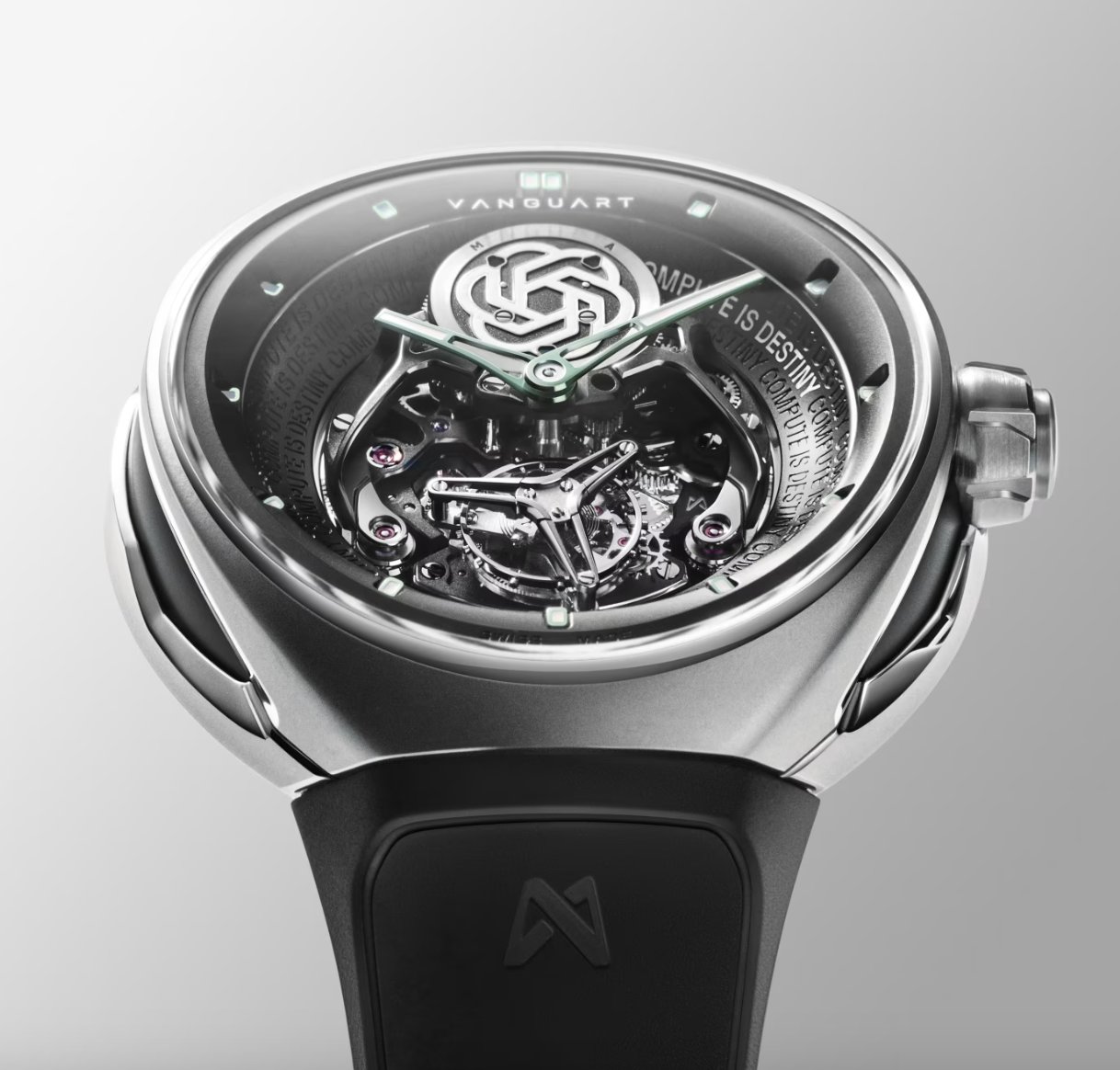
In late August 2026 it emerged that Sam Altman, the head of OpenAI, had given a watch to around four hundred of his employees. Almost all received the same one: a Tudor Pelagos 39 in titanium, reference 25407N, the OpenAI logo on the dial and, on the back of the case, an engraved line, “Good Research Takes Time”. The company that sells the compression of scientific research time had it written on the wrists of its engineers. Boris Power, head of applied research at OpenAI, confirmed the run on X. A smaller circle is said to have received more: seven pieces from an independent workshop, Vanguart, whose current model sells for around 180,000 dollars. OpenAI has not confirmed that part. A few of the Tudors are already listed for resale on second-hand watch platforms, to buyers who have never set foot in the company. In the same weeks, employees of Google, Uber and Palantir have been showing Tudors of the same kind, in their house colours.
Giving a watch to those who work for you is an old custom. What the employer means to say with that object has changed several times in two generations. So has the employment bond the watch is meant to seal.
The twenty-five-year watch
In the middle of the twentieth century, the watch given by the company rewarded a duration. At Coca-Cola in the 1960s, an employee reaching twenty-five years of service received a gold watch whose dial carried the words “25 Years Service” and the name of the Atlanta firm. IBM kept the same count in its Quarter Century Club, entered after twenty-five years of service. The brand on the dial mattered little and changed across the decades. What the company was buying was the inscription.
Companies also placed orders to mark an event. In 1954 the airline SAS opened its polar route, Copenhagen to Los Angeles over the north, and ordered a series of watches from Universal Genève for the occasion. The dial carried the airline’s monogram; around one hundred and seventy pieces came out badged this way, on a design the brand attributes to Gérald Genta, then a young unknown. The first transpolar flight took off on 15 November 1954. Ordinarily an order of that kind leaves nothing behind once the occasion has passed. This one was the exception: stripped of the SAS monogram, the watch entered the catalogue under the name Polerouter and stayed there for years. Universal Genève gained one of its classics from it.
For Swiss watchmakers, such orders remained a sideline, a dial badged to order for a company wanting to mark an anniversary or single out its best people.
The day Tom Monaghan took off his watch
In 1977 Tom Monaghan, the founder of Domino’s Pizza, took the watch off his wrist and gave it to the franchisee with the best sales. The gesture became a rule: each year, any outlet passing a certain weekly revenue won its watch. It rewarded a commercial result, measured by the week, where the jubilee measured loyalty in decades. The account of that scene comes from Monaghan’s autobiography, Pizza Tiger, published in 1986; the exact terms of the first challenge remain those of a memory.
For more than forty years, until the turn of the 2020s, Domino’s rewarded its best franchisees with a Rolex Air-King badged with its name, going to the highest-performing American outlets, a small fraction of the network. In 2022 the Omega Challenge took over: a Speedmaster Moonwatch, Domino’s logo on the strap, reserved for the American outlets scoring highest on operating criteria, in the order of 2 per cent of the network.
That change of brand is probably explained by unease on the Rolex side. A watch stamped with the name of a pizza chain and handed out every year sat less and less easily with the image of exclusivity the house cultivated and with a distribution network that had grown very narrow. For Domino’s the logic has not moved: a management device, with its thresholds and its percentages, using a luxury watch as a performance bonus.
A Tudor that cannot be bought
Since the start of the 2020s another logic has taken hold, one that calls for neither seniority nor performance. It is enough to have been part of the company at the right moment.
At Google, the employees’ internal watch club had a Tudor Pelagos 39 produced in titanium, its dial carrying the small dinosaur that appears in the Chrome browser when the connection drops. More than six hundred examples, ordered in advance, delivered at the end of 2024. Three years earlier Apple had commissioned fewer than a hundred Tudor Black Bay 58s nicknamed “Pirate”, after a line attributed to Steve Jobs to the effect that it is better to be a pirate than join the navy. One of them fetched close to 14,000 dollars at Christie’s in 2023.
Around every series a parallel market forms. Employees trade the pieces, and they resell to outside buyers: one example of the Google Tudor went back on sale at around 10,000 dollars, more than double its catalogue price.
That market stays narrow, and this is what drives the prices up. A corporate series is counted in dozens or a few hundred pieces, where a current Tudor reference is produced continuously, year after year. Their first owners mostly keep them as the memento of a moment, not as an investment, and few examples circulate. The rare ones that come back to market meet a demand nothing else can satisfy, since the series is closed and no shop stocks it. A collector who wants the OpenAI Tudor or Google’s dinosaur Pelagos has to wait for a former employee to decide to part with it, and pay what that wait is worth. Each example sold at a high price pulls the going rate up and makes the next one harder to land.
The watchmakers’ calculation
Seen from the brands, these orders look like the ideal customer. A corporate series is paid at full price, settled in advance, with no retailer in between and none of the discounts granted to the distribution chain. The client company pays the full rate, whether the employees then keep the watch or resell it. And it circulates the name with no advertising budget: every badged dial worn inside a company of several thousand people is a shop window.
Tudor has found itself at the centre of this current. Apple in 2021, Google at the end of 2024, OpenAI in 2026, without counting the more discreet series spotted at Uber or Palantir: enough to look like a steady flow of business. Bremont owns it openly and gathers under the heading “Corporate & Special Projects” versions of its current models, produced for pre-vetted organisations and never offered to the public. Omega, for its part, inherited the Domino’s contract after the 2022 change.
The choice of Tudor is no accident. The brand ticks the boxes an engineers’ club expects, a military-looking diving case, a price around 4,000 to 5,000 dollars, and it borrows the aura of Rolex, its parent house, without Rolex having to let a foreign logo be engraved on its own dials. Domino’s showed the limit of the exercise: hand out badged watches in quantity and you wear out the name you are lending. It is that calculation which leads Tudor and Bremont to accept today what Rolex, on its own dials, refuses.
The context makes the windfall clearer. In 2025 the Swiss watch industry exported around 14.6 million watches, the lowest in decades (Federation of the Swiss Watch Industry, 2025 export statistics). The figure counts watches as they clear customs, not sales in shops. When volumes contract that far, a firm order for four hundred pieces paid without haggling stops being a folkloric sideline. Each of these series also sustains, on its own, a small second-hand market around the brand’s name, which the brand has neither to fund nor to run.
What this reveals
The gift watch has followed the slope of the bond it claims to honour. As the long career in one place ceased to be the norm, the object stopped rewarding a duration and started attesting a passage, a dated presence in a company nobody plans to stay in. The gift meant to retain is resold to strangers before it has even been worn.
Companies that sell the compression of research time give their engineers a mechanical watch whose principle has not moved in a century, with a note on the back saying that good research takes time.
The market has already priced what having been there is worth. Auction houses assign these series a going rate, a reference price, rewarding less the watch than what it attests: having been part of Google in 2024, of OpenAI in 2026. An identical Tudor without the logo trades at a fraction of that price.
It remains to be seen who is making the better deal. A watch house in search of a customer who pays full price, outside the network, asking for no discount and not reselling to speculate has one ready-made: the tech company that orders identity in batches of four hundred and feeds the second-hand rate itself. The dream customer of a watch house long wore the features of the patient collector. Today it may wear those of a corporation that buys belonging in bulk and knows, from the day of delivery, that some of the examples will go back on sale.
Sources: X account of Boris Power, head of applied research at OpenAI, August 2026
Wall Street Journal, report on the Vanguart watches ordered by OpenAI, August 2026 (part not confirmed by OpenAI)
listings for the Tudor Pelagos 39 “OpenAI” (ref. 25407N) on Chrono24 and Wind Vintage
public posts by employees of Google, Uber and Palantir, 2026
Fontaine’s Auction and Sotheby’s, entries for the Coca-Cola “25 Years Service” watches
IBM, historical archives (Quarter Century Club)
Universal Genève, article “Polerouter and the First Transpolar Flight”, universalgeneve.com
Tom Monaghan, Pizza Tiger, 1986
Domino’s, presentation of the Omega Challenge and its criteria (HighPerformanceLSM, merchandising partner licensed by Domino’s Global Operations)
The Express (Lock Haven), report on an Omega Challenge winner, September 2024
Loupe This, auction entry for the Tudor Pelagos 39 “Chrome Dino” commissioned by Google’s internal watch club
Tudor, official site (Pelagos 39, ref. 25407N)
Christie’s, entry for the 2023 sale of Apple’s Tudor Black Bay 58 “Pirate”
“Corporate & Special Projects” and “Military & Special Projects” pages of the Bremont site
Federation of the Swiss Watch Industry, 2025 export statistics, 29 January 2026, fhs.swiss.
Research and writing assisted by Claude Code.