Zenith Chronomaster Solo Sport: A Chronograph Stripped Down to Its Heartbeat
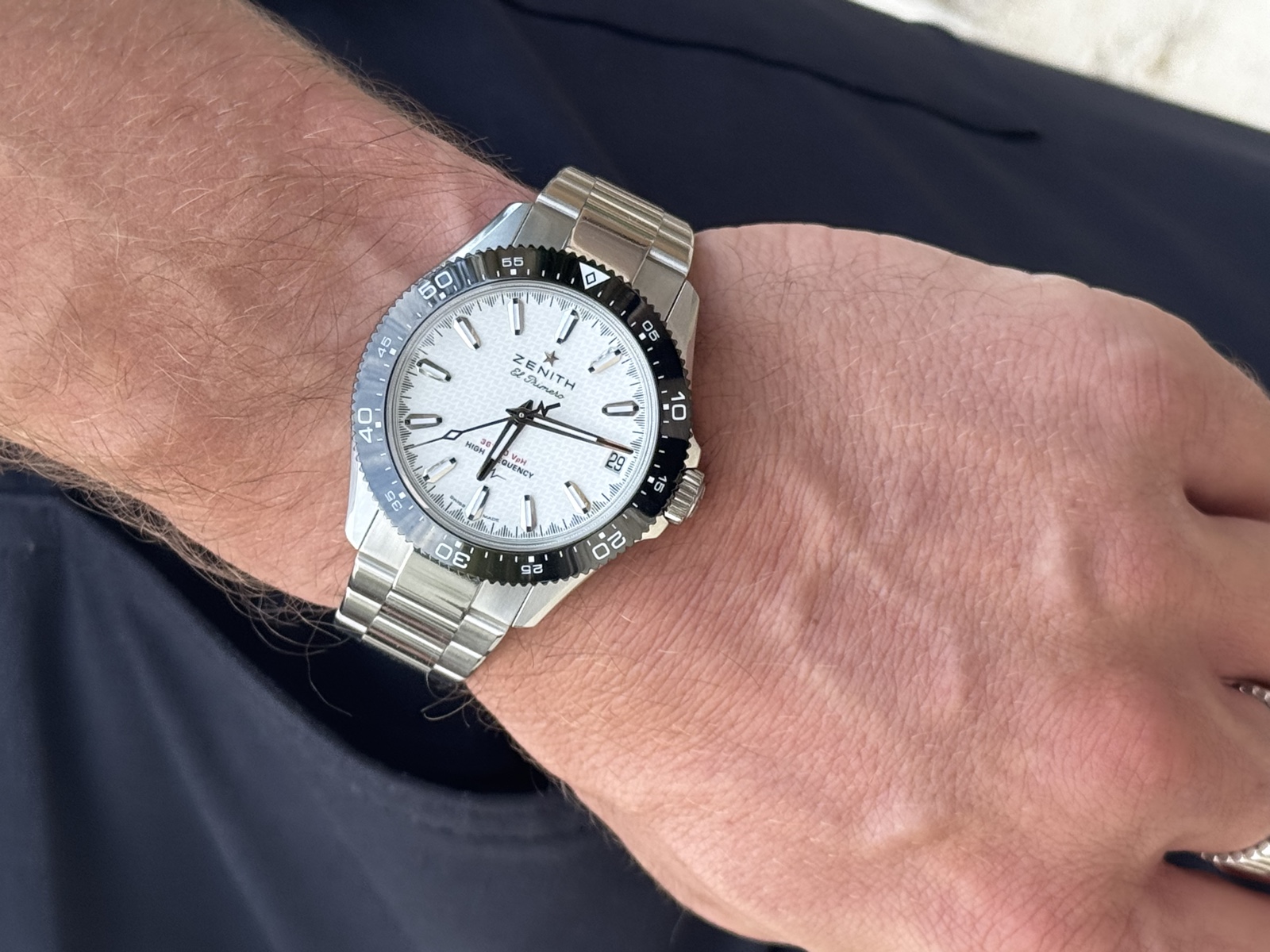
On 2 September 2026, at the Geneva Watch Days, Zenith presented the Chronomaster Solo Sport, a three-hand watch sold under a name that, since its creation, had never designated anything other than a chronograph. Chronomaster Original, Chronomaster Sport launched in 2021, Chronomaster Revival reissuing the historical references A386, A385 and A3817: the collection has always served as a showcase for the chronograph function of the El Primero calibre. The Solo Sport breaks that pattern. It shows the hours, minutes, seconds and, on three of its four references, the date. Nothing more.
The choice is worth pausing on, because it doesn’t consist of fitting a simple dial to a simple movement. It consists of taking one of the finest chronograph movements in watchmaking history and keeping only its essentials.
1969: what the El Primero actually changed
On 10 January 1969, Zenith unveiled calibre 3019 PHC under the name El Primero, presented as the world’s first integrated automatic chronograph. The technical nuance matters: unlike rival mechanisms developed the same year on a modular logic, the chronograph module was designed as integral to the base going train, which kept the movement thin while retaining a column-wheel mechanism. The other break, less commented on at the time than the chronograph function itself, concerned the frequency of the regulating organ: 36,000 vibrations per hour, or 5Hz, at a time when most series-produced mechanical watchmaking ran at 18,000 or 19,800 vibrations per hour. That rate allowed time to be read to within a tenth of a second, an unprecedented precision for a series-produced automatic movement.
The calibre then went through the quartz crisis under circumstances that have taken on something close to corporate legend within Zenith, before enjoying a second life from 1984 and later powering, in a modified version, the Rolex Daytona between 1988 and 2000. That episode did much for the El Primero name’s fame beyond the circle of Zenith collectors, but it doesn’t by itself sum up the calibre’s place in contemporary watchmaking. The movement has continued to equip the brand’s own production without interruption. Its most recent version, the El Primero 3600, won the Chronograph Prize at the Grand Prix d’Horlogerie de Genève in November 2021 for the Chronomaster Sport it powered. Fifty-seven years after its unveiling, the 5Hz reference remains an argument the brand keeps actively alive, not merely commemorates.
A stripped-down chronograph rather than a three-hand design built from scratch
The Chronomaster Solo Sport houses the El Primero 3620 calibre, explicitly presented by Zenith as derived from the El Primero 3600. The 3620 keeps the 3600’s base architecture, its 5Hz frequency, its silicon escapement, its stop-seconds function and its star-shaped openworked oscillating weight, but without the chronograph function itself. In the process, the movement gains power reserve, extended to 60 hours once freed of the energy load imposed by the column wheel and clutches of the chronograph module.
This is not a minor spec-sheet detail. A high-frequency three-hand movement designed from scratch would have nothing to prove on its dial: it would simply show the time. An ultra-capable chronograph stripped to its essentials keeps everything that justified its original complexity, minus the column wheel: the precision of the escapement, the robustness of a going train built to absorb the shocks of a clutch engagement, the industrial feat of a manufacture that has mastered series high frequency since 1969.
This architecture isn’t unprecedented in Zenith’s catalogue, however. The 3620 designation already existed before the Solo Sport: it has equipped the Defy Skyline since 2022, a high-frequency three-hand watch with an additional tenth-of-a-second display function, sold under references 03.9300.3620/xx.I001. In the absence of a detailed, publicly available component-by-component technical comparison, one cannot assert a strict identity between the two executions of the calibre, but they belong at the very least to the same architectural family. This continuity usefully tempers the narrative of an entirely original design gesture: the Solo Sport reuses, in different clothing, a base already amortised elsewhere in the range. The clearest proof of this lies in the price. The date-less version of the Solo Sport, at 8,900 Swiss francs, costs exactly the same as the steel 41mm Defy Skyline with date. The three dated versions of the Solo Sport, at 9,900 Swiss francs, differ only by the addition of a date window, priced at 1,000 Swiss francs. The design gesture here coexists with fairly conventional range management, recycling an existing movement rather than developing a new one for the occasion.
Why this stripping-back makes the watch versatile
Zenith claims a deliberately undetermined position for the Solo Sport: neither resolutely sporty nor strictly dressy, meant to accompany the different moments of the day rather than a specific occasion. That promise flows directly from the choice made on the dial.
A chronograph carries, by construction, a visual grammar that signals a use: pushers, counters, a possible tachymetric scale, all pointing to the idea of precisely timing an event, and therefore to an identifiable context, sporting or technical. By removing that grammar while keeping the engineering, Zenith obtains an object that carries the technical credibility of the high-frequency calibre without carrying the visual cues that would tie it to a particular moment of the day or a particular pursuit. The ceramic rotating bezel and the screw-down crown, securing water resistance to 20 ATM, keep a tool-oriented vocabulary, but nothing on the dial forces a reading of the watch as a timing instrument. It is the stripping-back of the dial that makes this versatility possible.
The motif chosen to dress that emptiness keeps the link with the calibre alive rather than letting it fade: the ceramic dial, offered in sunray white, polished black or polished brown, features a Z-pattern repeated at 45 degrees, presented by the brand as an evocation of the movement’s rhythm and vibrations. The rhetoric of high frequency, banished from the displays, returns through texture.
A manufacture under-recognised relative to what it makes
Zenith belongs to a narrow group of houses that design, produce and assemble their movements on a single site, without resorting to an outside movement maker, starting with the calibre fitted to the Solo Sport. That integration dates back to the manufacture’s founding by Georges Favre-Jacot in Le Locle in 1865, where it brought together from the outset, under one roof, trades usually scattered across the Neuchâtel valley. Maintaining this complete industrial capability, from the design of the movement to its finishing and the machining of its components, represents an investment that few watch companies of comparable size choose to sustain over time, most preferring to source all or part of their movements from third-party suppliers.
This industrial reality sits oddly alongside Zenith’s public recognition, noticeably lower than that of other houses in the sector that do not all share the same degree of vertical integration. No precise, publicly available figures allow a ranking of this comparative recognition to be established, but the gap between the esteem for the know-how within the watchmaking world and the brand’s visibility with the general public is a widely shared qualitative observation, including within the group’s own institutional communication.
Zenith joined LVMH in 1999, bought from its previous industrial owner, the Dixi company. It has since belonged to the Watches and Jewellery division, alongside Bulgari, TAG Heuer, Hublot and Tiffany, a division that generated 5.23 billion euros in revenue in the first half of 2026, up 9% in organic growth, a progression the group attributes mainly to Bulgari and Tiffany. LVMH does not publish results specific to Zenith, which rules out any estimate of its real weight within that whole. The launch of the Solo Sport also comes against the backdrop of a declining Swiss market: Swiss watch exports reached 25.6 billion Swiss francs in 2025, down 1.7% year-on-year, for 14.6 million pieces sold, down 4.8%, according to the Federation of the Swiss Watch Industry.
What this reveals
The Chronomaster Solo Sport mainly says something about how a vertically integrated manufacture can circulate one technical asset, the high-frequency calibre, across several collections and several commercial promises, from the competition chronograph displayed on the Chronomaster Sport to the urban tool that is the Defy Skyline (which adopted a comparable philosophy to the Chronomaster Solo Sport with the 3620 calibre), through to the everyday accessory the Solo Sport wants to be. Same engine, different motivations.
This internal circulation is not unique to Zenith, but it is more visible at a manufacture that makes everything itself than at a brand sourcing standardised movements from a third party. The aesthetic gesture of stripping back is real and coherent. It rests on an industrial base already amortised elsewhere. Elsewhere, some might call that recycling. With the Chronomaster Solo Sport, Zenith pulls off the exercise of showcasing its historical technical heritage, adapted to its era and its clients.
Key figures
Calibre: El Primero 3620, derived from the El Primero 3600 chronograph, frequency 5Hz (36,000 vph), 60-hour power reserve, silicon escapement. Case: steel, 40mm, unidirectional rotating ceramic bezel, water resistance 20 ATM. Price of the three dated versions (white, black, brown): 9,900 Swiss francs each. Price of the date-less black version: 8,900 Swiss francs, identical to the price of the steel 41mm Defy Skyline with date, which has shared the same 3620 calibre family since 2022. Price gap linked to the date between the two Solo Sport configurations: 1,000 Swiss francs. Original El Primero calibre: presented 10 January 1969, first high-frequency integrated automatic chronograph, 5Hz. LVMH, Watches and Jewellery division, first half of 2026: 5.23 billion euros in revenue, +9% organic, growth driven mainly by Bulgari and Tiffany. Swiss watch exports 2025: 25.6 billion Swiss francs (-1.7% year-on-year), 14.6 million pieces (-4.8%), according to the Federation of the Swiss Watch Industry.
Sources: Zenith press release of 2 September 2026, “Chronomaster Solo Sport: the essence of high frequency”; product pages and reference sheets on zenith-watches.com; pressroom.zenith-watches.com, press release of 4 November 2021 on the Chronograph Prize won by the Chronomaster Sport at the GPHG; gphg.org, 2021 results; lvmh.com, Zenith house page and LVMH’s first-half 2026 results release; Federation of the Swiss Watch Industry, fhs.swiss, 2025 export statistics.
Research and writing assisted by Claude Code.