Métiers d'art: when craft speaks with emotion
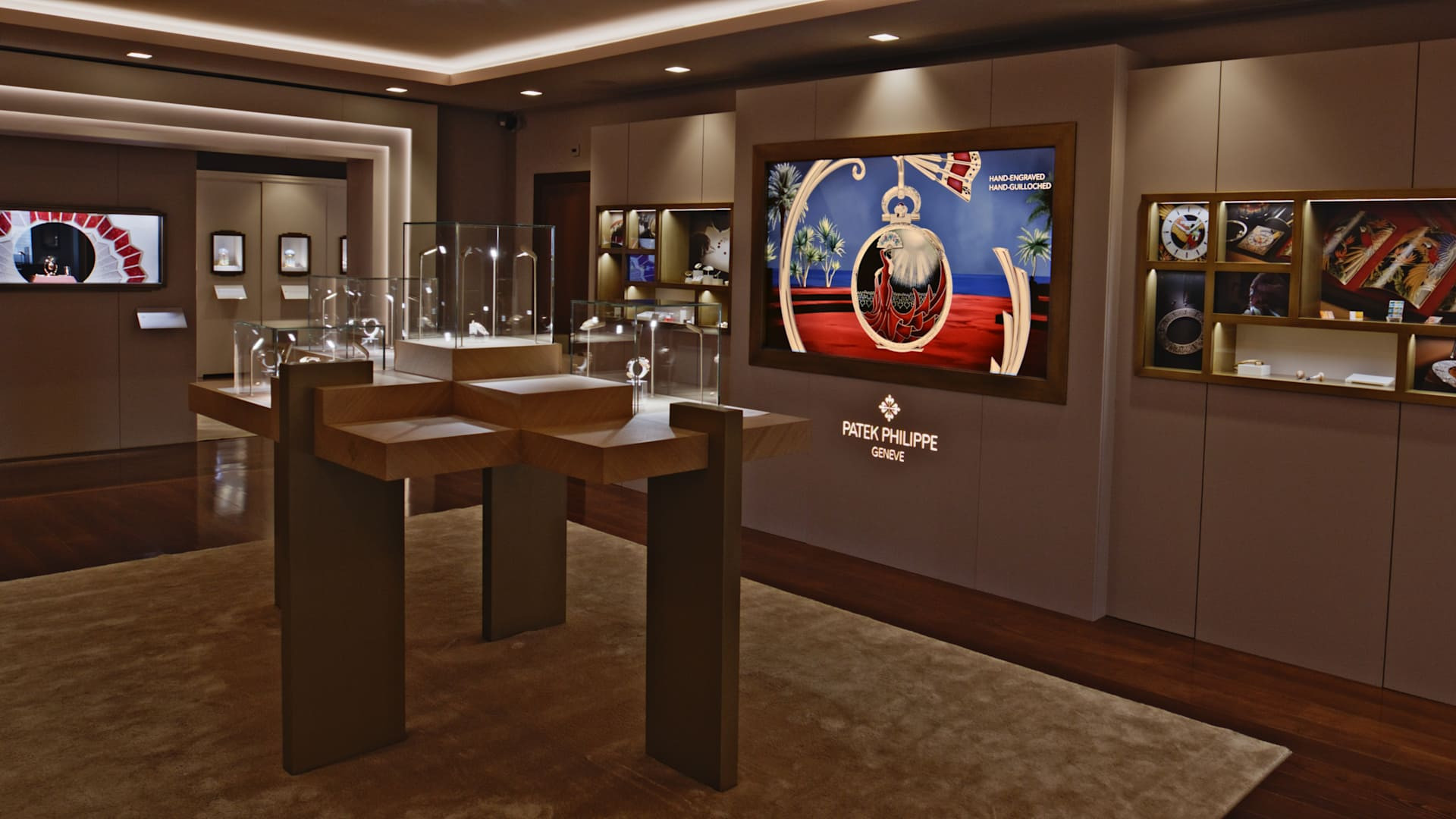
From 18 April to 9 May 2026, in Geneva, Patek Philippe opened its salons on the rue du Rhône to the public to show 65 new creations: 23 dome clocks, 10 pocket watches and 32 wristwatches. Artisans worked there in front of visitors, at engraving, enamelling, gem-setting and marquetry. People registered to come and look. It was, according to the house, the only chance to see these pieces before they joined private collections.
In watches as elsewhere, desire feeds on recognition more than on merit. A watch is coveted all the more when it can be identified at a glance, on someone else’s wrist. A piece made in ten examples, sometimes in one, has no chance of being recognised, since almost nobody has ever come across it. The watches known as métiers d’art find their collectors. The craving of the many, the kind that sets a watch’s market value, goes elsewhere: they are admired without being desired.
In the phrase “métier d’art”, the houses mostly sell the first word: the craft. They count the hours and the firings, as though patience were enough to justify the object. The second word stays in the shade. Yet art is more than craftsmanship, and it claims another dimension, that of emotion conveyed. Van Cleef & Arpels stands as something of an exception with its Poetic Complications, launched in 2006. Rainer Bernard, who heads watchmaking research and development there, sums it up this way: the story to be told is what decides the watch. The other dials can be looked at in the same manner, by asking what each one risks and what it shows.
What the kiln gives back
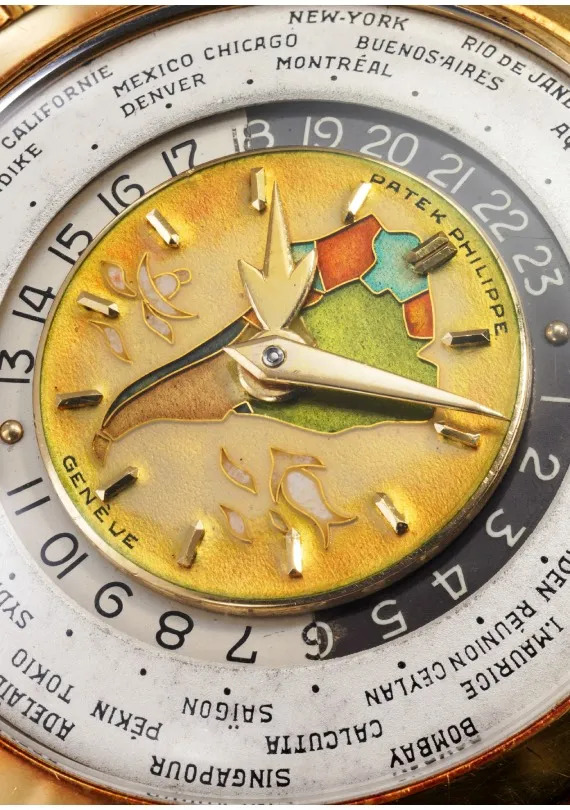
On 9 May 2026, the last day of that exhibition, Phillips sold in the same city, before a packed saleroom, a 1953 Patek Philippe for 7,961,000 Swiss francs, or 10,245,807 dollars, a record for the reference in that currency. It is a 2523 in yellow gold, a two-crown world time built on the system devised by Louis Cottier, and this example had appeared at public auction only once, in 1988. What bidders fought over that day sits on a disc of cloisonné enamel bearing the map of South America, one of two examples known. It took seventy-three years to become a watch people recognise.
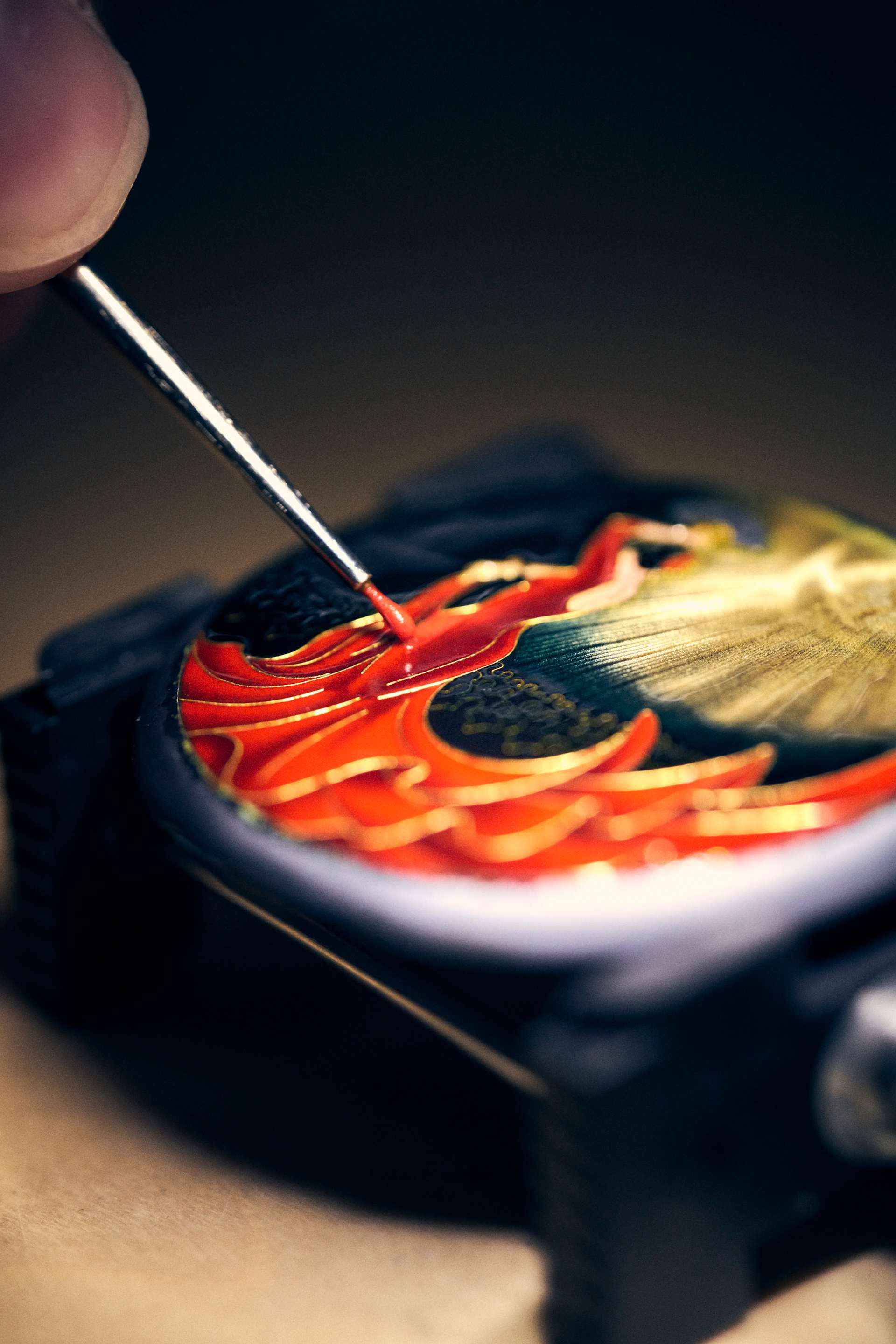
That dial began as a gamble. A cloisonné goes back into the kiln as many times as its colours demand, at more than 800 °C, and every firing puts all the work already done at risk. A crack or a mere speck of dust is enough to send it to the reject pile, and workshops lose a great many. Whoever closes the kiln door does not know what will come out.
On the reference 2523, three geographical motifs are known: Eurasia, North America and South America. The dial maker Stern Frères supplied such dials to Swiss brands at the time, and the auction house does not name the hand that enamelled this one. The detail that stops the eye lies out at sea. On the stretches of ocean, where the map had nothing left to indicate, someone placed a sailboat and a sea creature. At that spot, the hand stopped tracing an outline and began to tell of a voyage, a story.
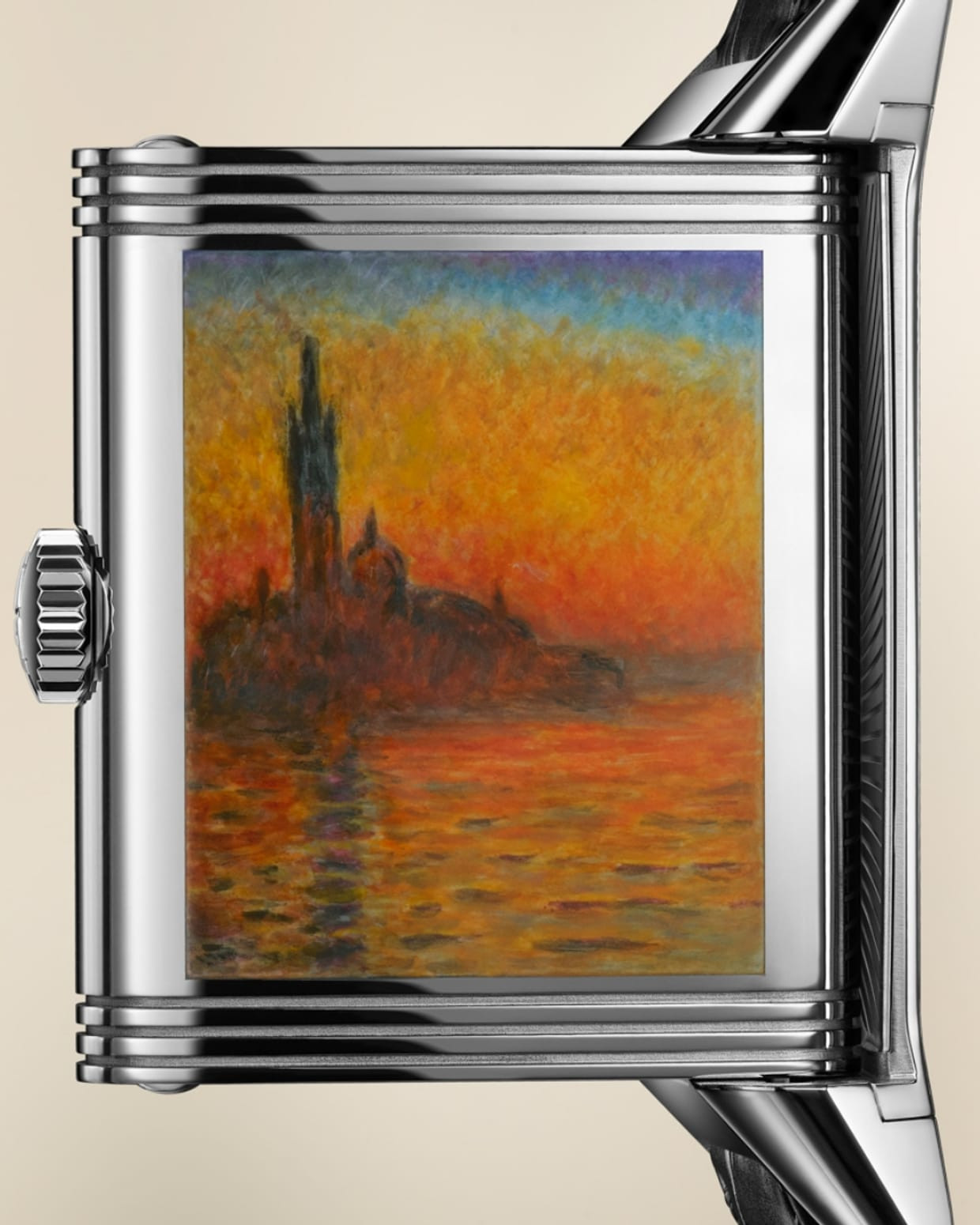
Miniature painting on enamel entrusts everything to the brush before handing it back to the kiln. In 2024, Jaeger-LeCoultre’s enamellers painted three views of Venice after Claude Monet, San Giorgio Maggiore, The Grand Canal and The Doge’s Palace, on the back of the Reverso Tribute Enamel. The painting sits on the side one turns towards oneself or towards others, depending on mood.
Grisaille starts from darkness: on a ground of dark enamel, Limoges white is laid on with a brush, and the enameller quite literally draws the light. Patek Philippe had it play jazz with the 5089G-067, created for its New York exhibition in 2017, in which a singer, a pianist and a skyline of towers emerge from the black.
Paillonné brings gold into enamel, as motifs set by hand and then covered with a translucent enamel. Jaquet Droz’s Petite Heure Minute Paillonnée has a history of its own. In the mid-2000s, the first dials were entrusted to the enameller Anita Porchet, who held a stock of antique paillons. The house later took production in-house, and has since made its own paillons.
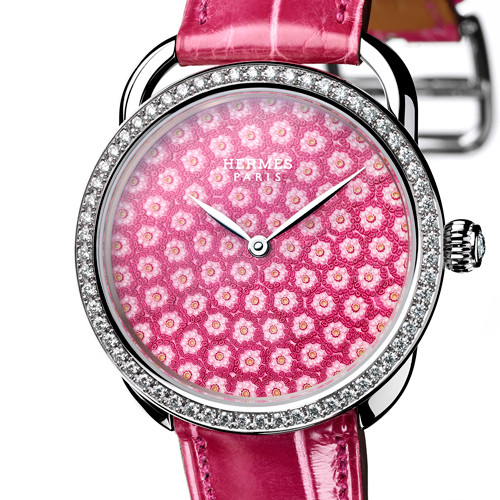
Glass borrows from fire without going through enamel. For the Arceau Millefiori of 2014, Hermès turned to the Cristalleries de Saint-Louis, founded in 1586. Rods of coloured crystal are blown, stretched, cut and stood upright in a cast-iron mould until they form a carpet of flowers, then caught under a dome of clear crystal. It is the paperweight technique, thinned down to the thickness of a dial.
Two hundred and nine pieces for a canyon
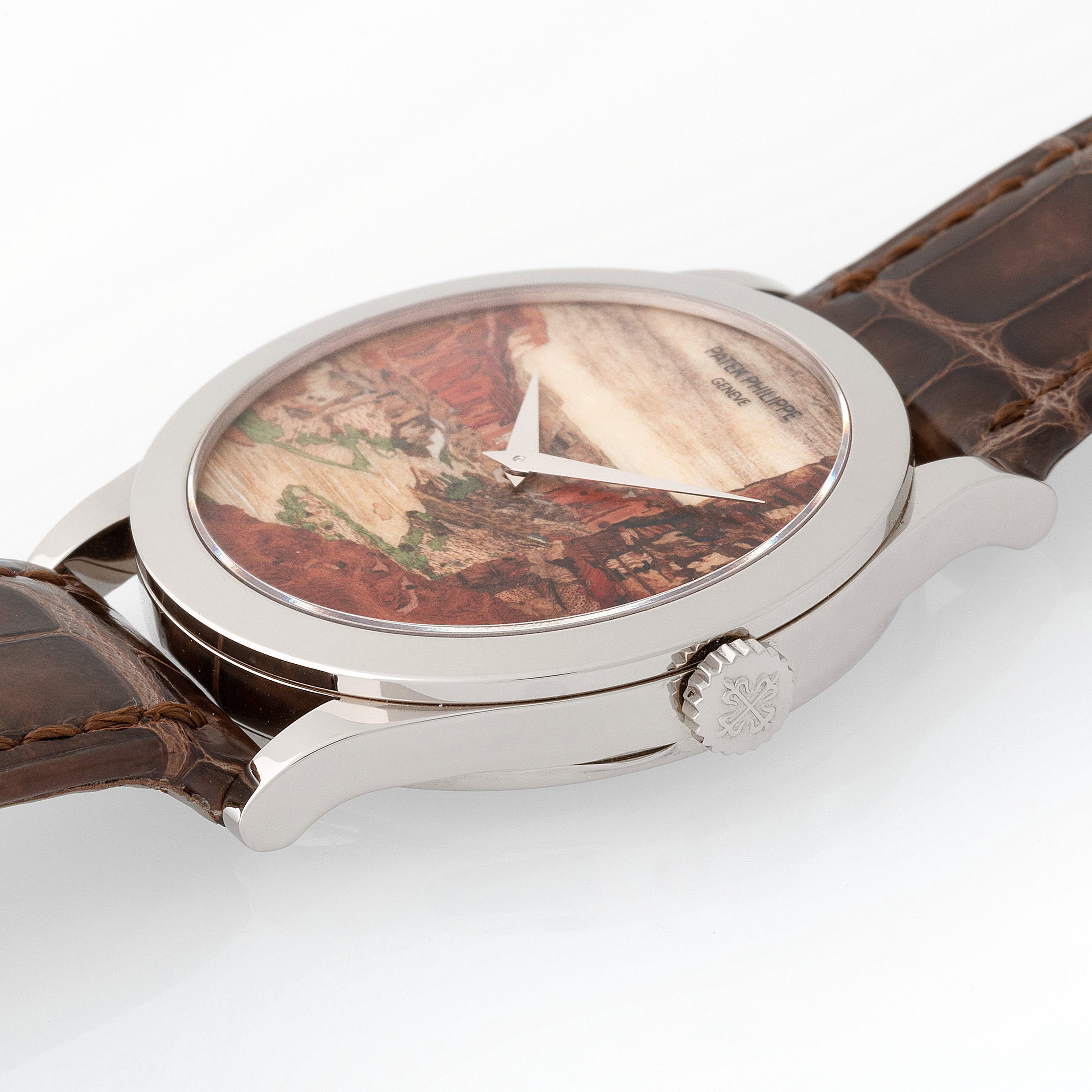
Marquetry has no kiln to betray the artisan. The image is built fragment by fragment, and it does not exist until the last one has found its place. In 2017, for the same New York exhibition, Patek Philippe fitted the Grand Canyon into a 38.6 mm case. The dial of the 5089G-066 brings together 209 pieces of wood drawn from 20 species, which alone must render the rock, the cast shadow and the dizzying depth of a gorge.
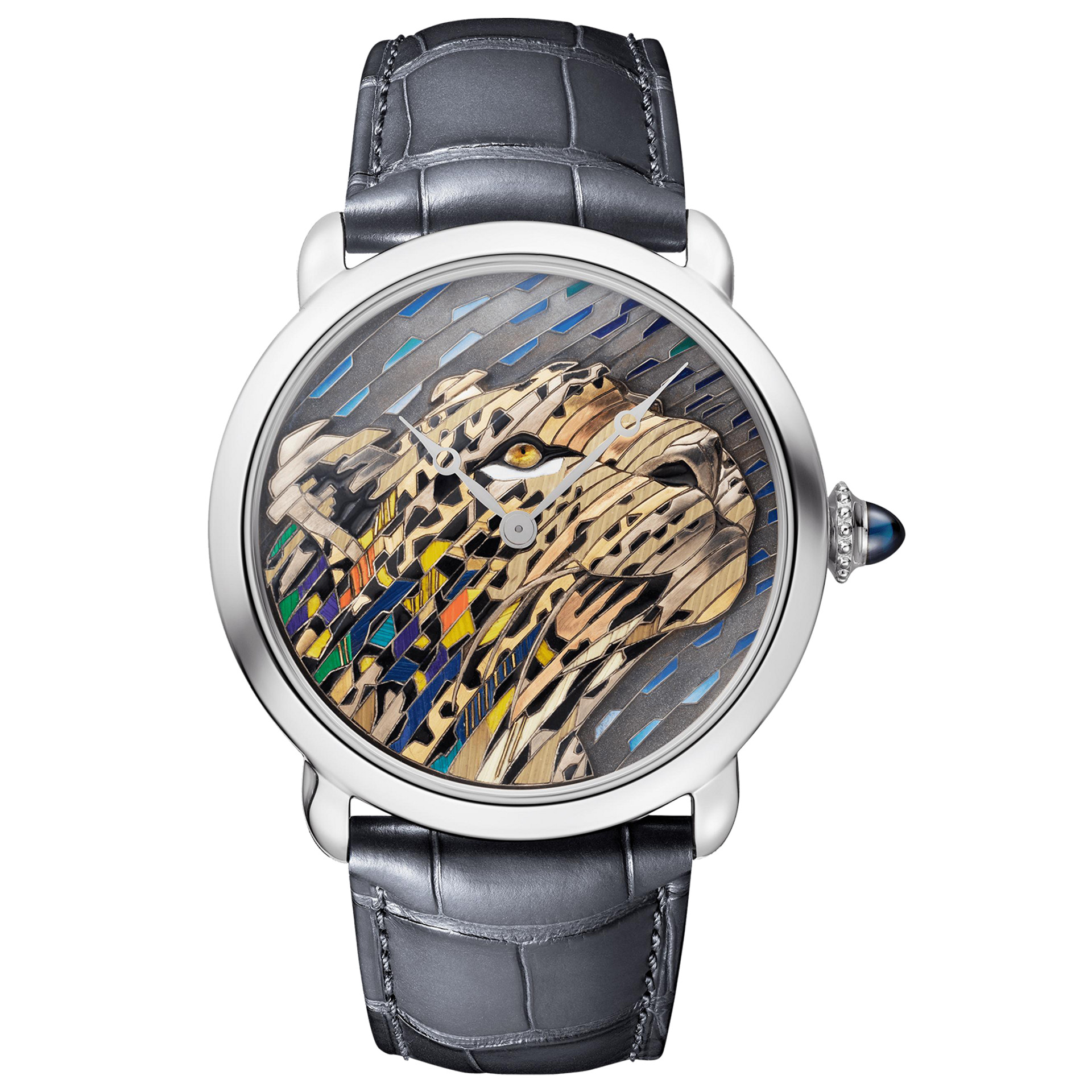
Straw takes the game further, because it begins with a stalk that is split and flattened. In 2020, Cartier set a panther’s head in white, yellow and pink gold among blades of straw dyed in eleven colours, on the Ronde Louis Cartier Straw and Gold Marquetry. The straw holds the same rank there as the precious metal, and makes one forget what it started as.
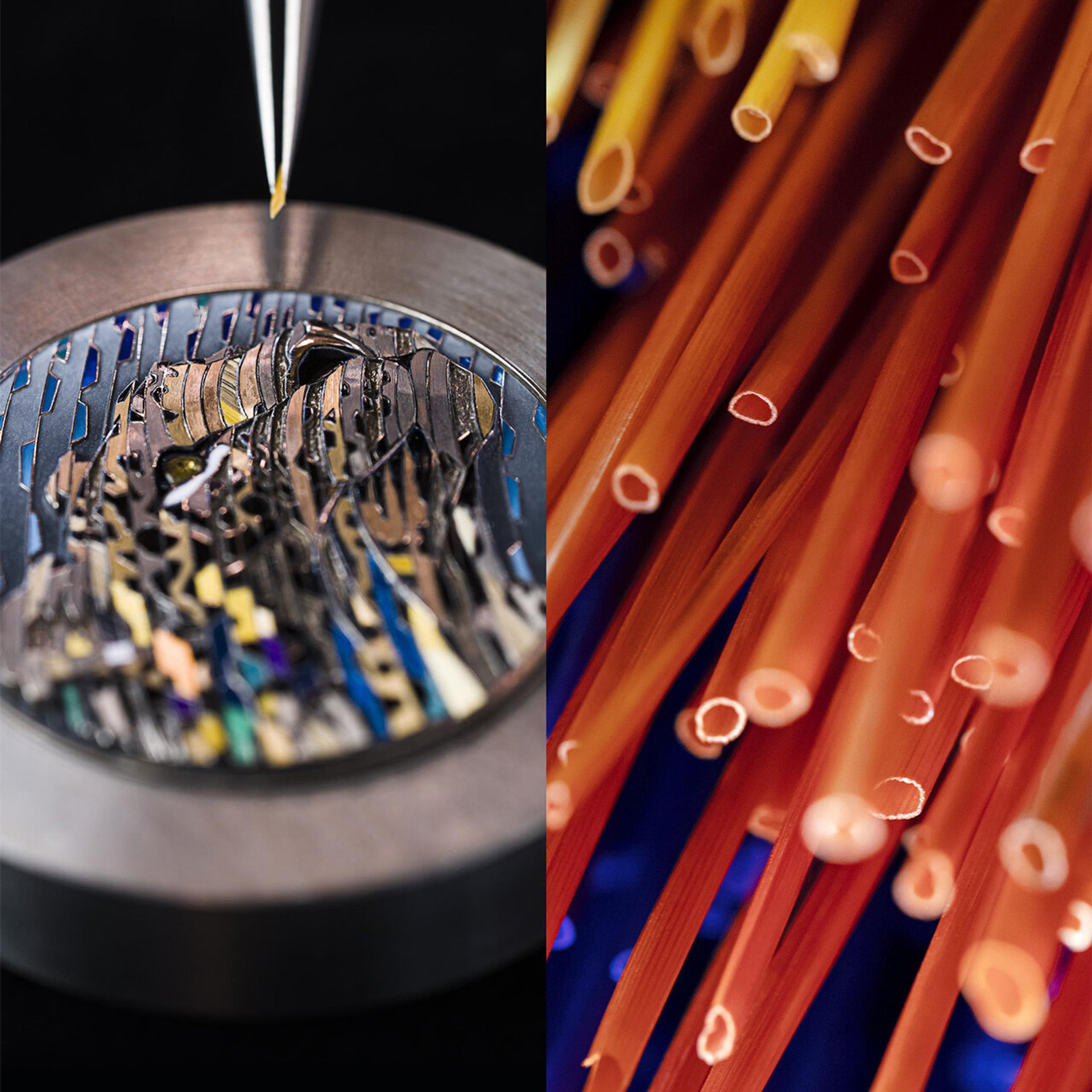
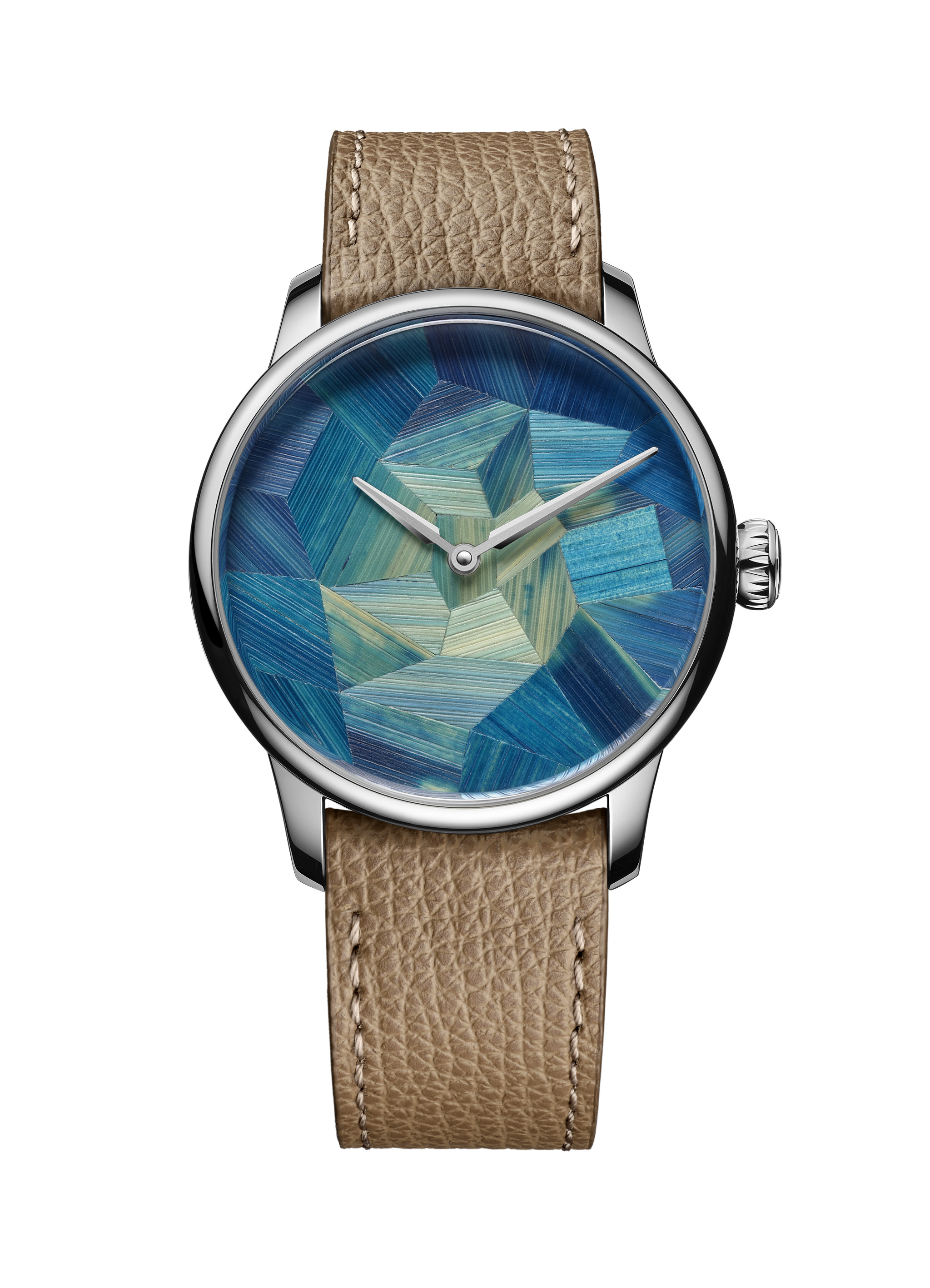
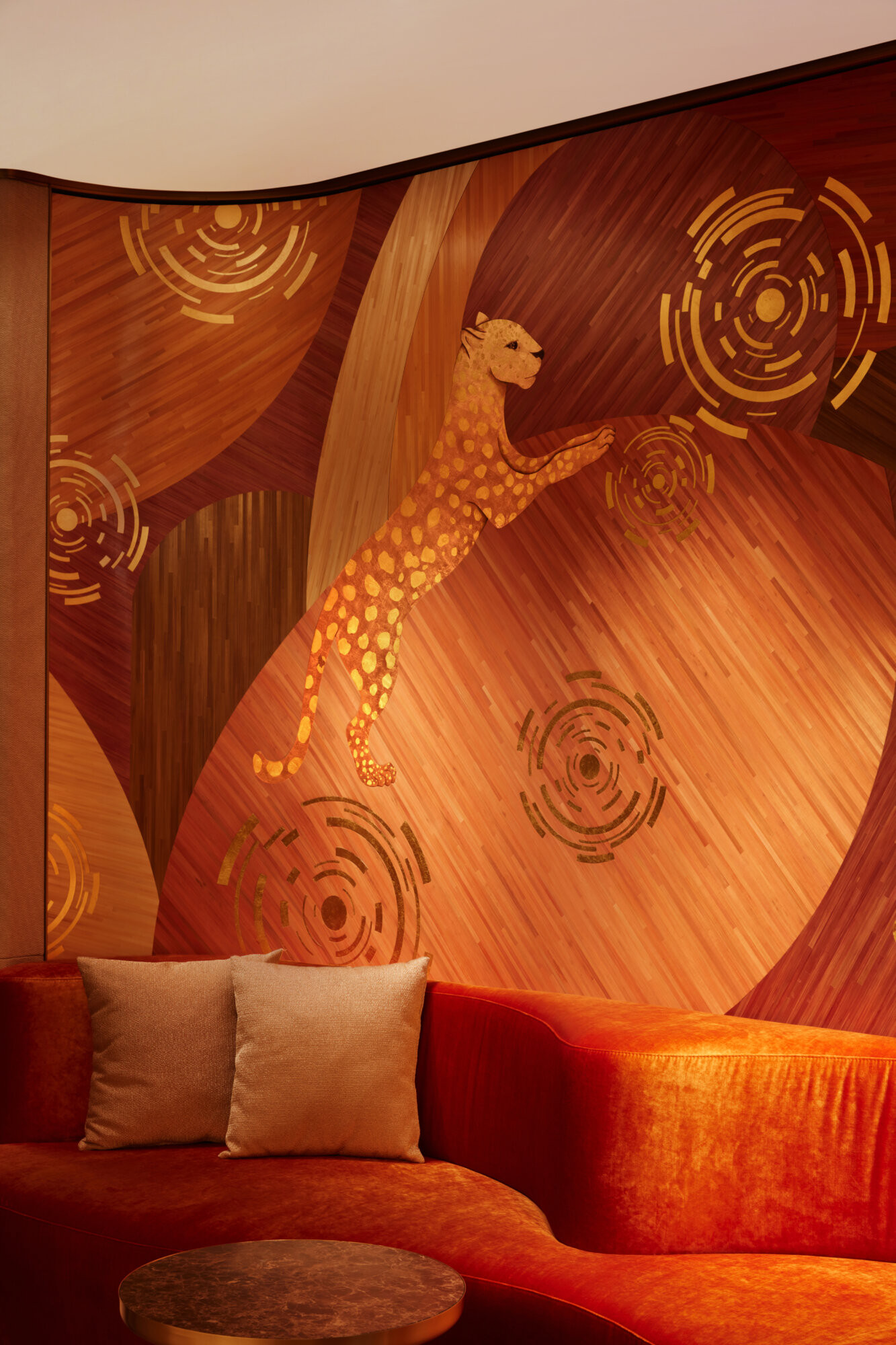
This material, simple and basic yet so complex, sober yet so brilliant, is in fact coming back into favour, and not only in confidential series. In 2026, Louis Erard put it on a steel watch at 4,500 Swiss francs, with a rye-straw dial composed by the Portuguese artisan Bernardo d’Orey. Beyond watches, the Ateliers Lison de Caunes have clad the salon of Cartier’s Geneva boutique in straw marquetry.
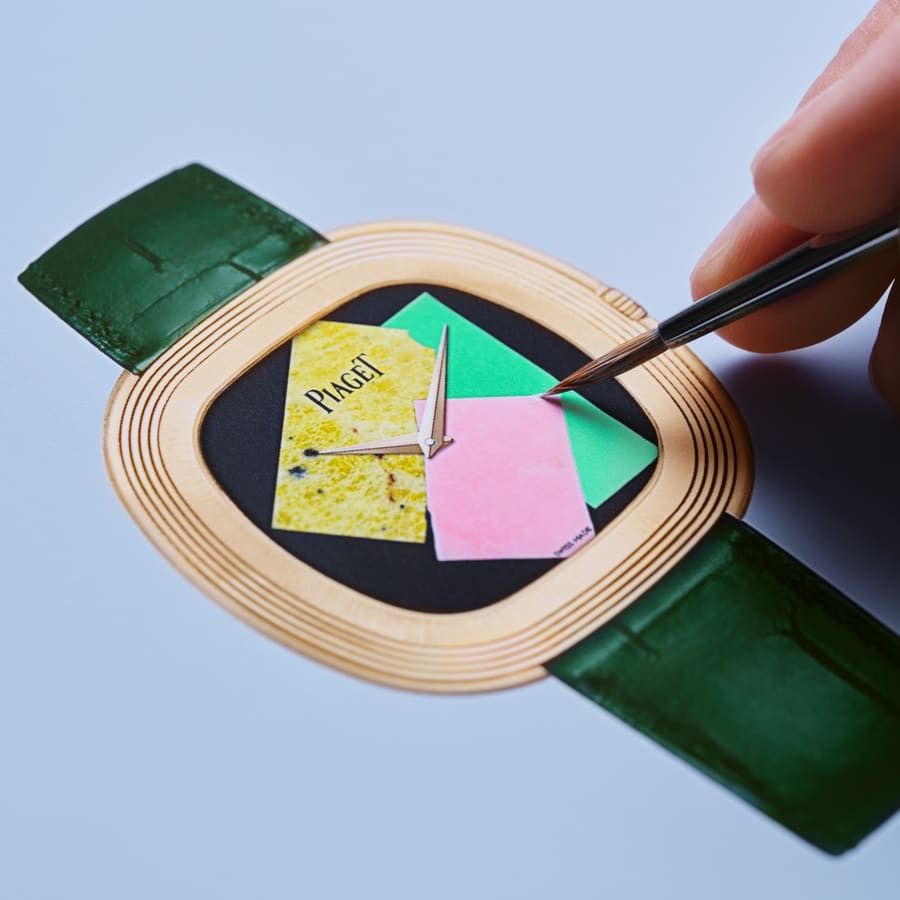
At Piaget, stone is sliced into thin plates, cut by hand and then assembled. In October 2025 the house used them for the Andy Warhol Collage, made under licence from the Andy Warhol Foundation, in which black onyx, yellow serpentine, pink opal and green chrysoprase recompose a self-portrait of 1986. On a smaller scale still, the micro-mosaic of the Rotonde de Cartier with tortoise motif, in 2011, drew the animal in more than a thousand stone tesserae, each less than a millimetre across. In 2014, the same house composed a parrot’s plumage, on a Ballon Bleu, from flower petals gathered, dyed and cut one by one. The beak is onyx, the eye an emerald.
Feather and thread
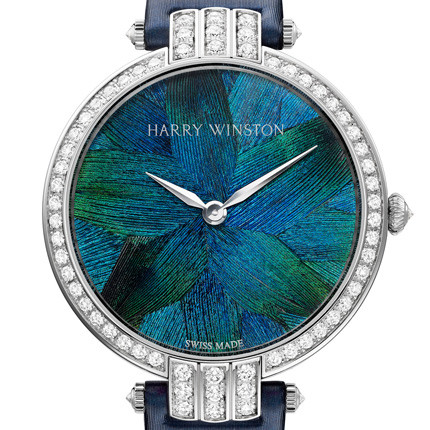
The enameller prepares the powder, the marquetry maker splits the straw. The feather artist receives her material ready-made, and nobody knows how to manufacture it. When Harry Winston unveiled the Premier Feathers at Baselworld in 2012, the dials were by Nelly Saunier, a Maître d’art since 2008. The feathers came from farmed birds: silver pheasant, Lady Amherst’s pheasant, peacock, ring-necked pheasant, one dial per species. The work begins with choosing the raw material carefully, feather by feather.
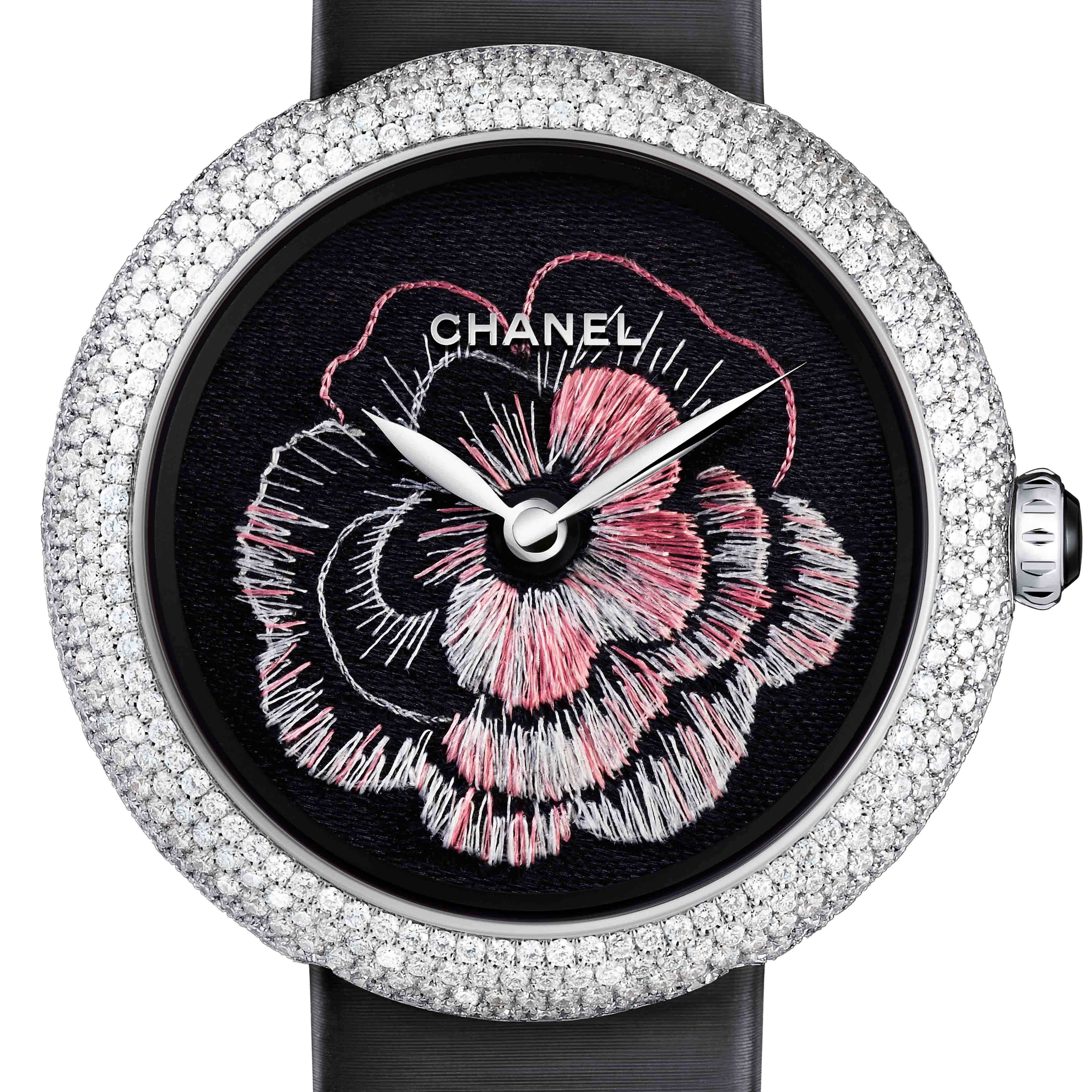
Thread entered the watch the following year. In 2013, Chanel entrusted the house of Lesage with the dial of the Mademoiselle Privé Camélia Brodé, which won the Artistic Crafts Watch Prize at the Grand Prix d’Horlogerie de Genève that same year. A camellia is shaded there in silk thread, stitch by stitch, as on a haute couture dress.
From gold dust to the burin
In the early 2010s, Vacheron Constantin presented La Symbolique des Laques, made with Zôhiko, a Kyoto lacquer house founded in 1661, almost a century before the Geneva firm. The technique is called maki-e, which means sprinkled picture. The motif is drawn in lacquer, then gold or silver powder is poured onto that lacquer while it is still wet, in the short interval during which it accepts the metal. The first set paired pine and crane, bamboo and sparrow, plum tree and nightingale.
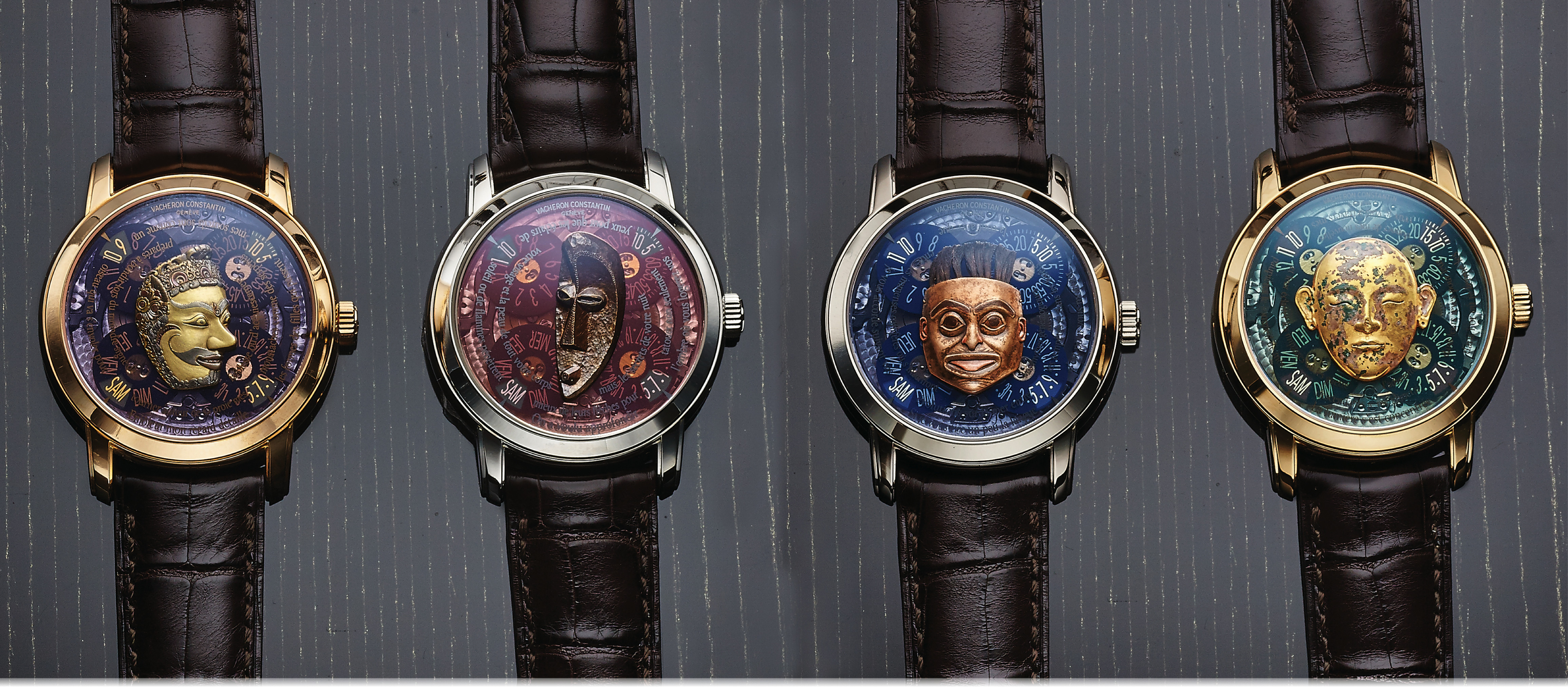
Engraving gave the same house a stranger series. From 2007 to 2009, Vacheron Constantin presented Les Masques, four a year, after twelve masks from the Barbier-Mueller museum in Geneva reproduced in gold. Each mask was scanned in three dimensions and its volumes transferred by laser. The engraver came in afterwards, with the burin, reworking hollows and reliefs down to the marks of time. The laser gave the volumes, and the mask owes its age to the burin. Around each mask runs a prose poem by Michel Butor, in gold letters deposited on the sapphire, which can be read only at certain angles of light, like a treasure that has to be earned by looking at the piece attentively.
Glyptics carries that work into stone. On the Mademoiselle Privé Coromandel Glyptique of 2015, Chanel had turquoise, carnelian, lapis lazuli and mother-of-pearl carved into birds and flowers, after the Coromandel screens.
Noon, midnight
On some dials, the image moves. In 2010, Van Cleef & Arpels presented the Lady Arpels Pont des Amoureux, which won the Ladies’ Watch Prize at the Grand Prix d’Horlogerie de Genève that same year. Two lovers stand at either end of a bridge, against a decor in grisaille enamel. She shows the hours, he the minutes, on a double retrograde display. They meet in the middle at noon and at midnight, then go back each to their own side of the dial.
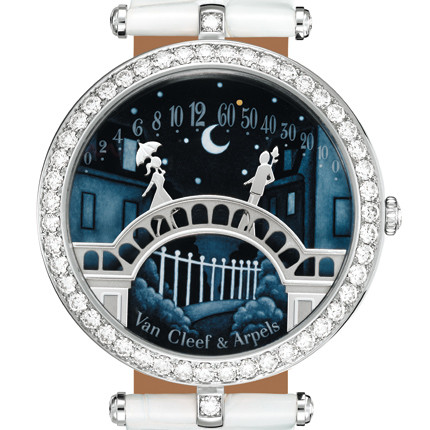
She takes twelve hours to arrive. He walks the path again hour after hour, and finds her in the middle of the bridge only twice a day. The watch sets up a wait, resolves it for an instant and starts it again. On recent versions, a pusher replays the meeting on demand. In front of this dial, nobody thinks of counting the firings the sky required. What stays is having watched the time in order to witness a rendezvous that was not one’s own.
Keeping a gesture alive
Nobody buys these watches to be recognised. They are bought for oneself, for those moments when the wrist is tilted without looking for the time. One finds a sailboat lost on an ocean of enamel, two silhouettes waiting for each other on a bridge and, beneath the image, by dint of looking, the gesture of the artisan. Or rather, of the artist.
That reason would be enough. There is, however, another, less visible. These crafts live elsewhere, on a wall, a dress or a screen. Their reduction to the size of a dial lives only through the watch, and no house keeps it in the catalogue for long if the pieces do not find buyers. Jaquet Droz’s paillons show the other half of the road: a skill that hung on an old stock becomes a practice again when a house decides to take it up. It only takes it up if the piece sells.
Whoever acquires a métiers d’art watch carries a craft and artistic heritage condensed into its most precise expression, and becomes, knowingly or not, the keeper of a gesture. The Geneva sale did not name the hand that enamelled the dial of 1953. Its sailboat crossed seventy-three years before filling a saleroom, one day in May. It sails on, so long as someone looks at it.
Sources: Patek Philippe, “Rare Handcrafts 2026” exhibition, Geneva, 18 April to 9 May 2026 (patek.com); Phillips, The Geneva Watch Auction XXIII, Geneva, May 2026, result for the reference 2523 and article “The Art of Cloisonné Enamel Dials”, April 2026 (phillips.com); Phillips, Hong Kong sale, lot 850, reference 5089G-067 (phillips.com); Monaco Legend Auctions, Exclusive Timepieces, lot 170, reference 5089G-066; Grand Prix d’Horlogerie de Genève, list of winners 2001-2018 (gphg.org); Fondation de la Haute Horlogerie, entries for the Ronde Louis Cartier Straw and Gold Marquetry and the Lady Arpels Pont des Amoureux (hautehorlogerie.org); Louis Erard, product page for the Marqueterie de Paille (louiserard.com); Ateliers Lison de Caunes, Cartier Geneva project (lisondecaunes.com); Fondation Bettencourt Schueller, entry on Nelly Saunier (fondationbs.org).
Research and writing assisted by Claude Code.